Lee also describes one of his most controversial proposals: tax breaks and schooling incentives to encourage educated men and women to marry each other and have children. "Our best women were not reproducing themselves because men who were their educational equals did not want to marry them.... This lopsided marriage and procreation pattern could not be allowed to remain unmentioned and unchecked," writes Lee. Most of the book, however, is a chronicle of how Lee helped create so much material prosperity. Anticommunism is a strong theme throughout, and Lee comments broadly on international politics. He is cautiously friendly toward the United States, chastising it for a "dogmatic and evangelical" foreign policy that scolds other countries for human-rights violations, except when they interfere with American interests, "as in the oil-rich Arabian peninsula." Even so, he writes, "the United States is still the most benign of all the great powers.... [and] all noncommunist countries in East Asia prefer America to be the dominant weight in the power balance of the region." From Third World to First is not the most gripping book imaginable, but it is a vital document about a fascinating place in a time of profound transition. --John J. Miller
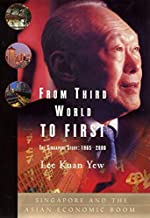
From Third World to First: The Singapore Story - 1965-2000
📄 Viewing lite version
Full site ›
Book Details
Author(s)Yew, Lee Kuan
PublisherHarper
ISBN / ASIN0060197765
ISBN-139780060197766
AvailabilityIn Stock.
Sales Rank44,982
CategoryBiography & Autobiography
MarketplaceUnited States 🇺🇸
Description ▲
In this memoir, the man most responsible for Singapore's astonishing transformation from colonial backwater to economic powerhouse describes how he did it over the last four decades. It's a dramatic story, and Lee Kuan Yew has much to brag about. To take a single example: Singapore had a per-capita GDP of just $400 when he became prime minister in 1959. When he left office in 1990, it was $12,200 and rising. (At the time of this book's writing, it was $22,000.) Much of this was accomplished through a unique mix of economic freedom and social control. Lee encouraged entrepreneurship, but also cracked down on liberties that most people in the West take for granted--chewing gum, for instance. It's banned in Singapore because of "the problems caused by spent chewing gum inserted into keyholes and mailboxes and on elevator buttons." If American politicians were to propose such a thing, they'd undoubtedly be run out of office. Lee, however, defends this and similar moves, such as strong antismoking laws and antispitting campaigns: "We would have been a grosser, ruder, cruder society had we not made these efforts to persuade people to change their ways.... It has made Singapore a more pleasant place to live in. If this is a 'nanny state,' I am proud to have fostered one."
Similar Products ▼
- Lee Kuan Yew: The Grand Master's Insights on China, the United States, and the World (Belfer Center Studies in International Security)
- The Singapore Story: Memoirs of Lee Kuan Yew, Vol. 1
- The Wit and Wisdom of Lee Kuan Yew
- Deng Xiaoping and the Transformation of China
- Singapore: Unlikely Power
- The Singapore Story: Memoirs of Lee Kuan Yew, Vol. 2: From Third World to First, 1965-2000
- The Great Mental Models, Volume 2: Physics, Chemistry and Biology
- What It Takes: Lessons in the Pursuit of Excellence
- Hard Truths to Keep Singapore Going
- The Man Who Solved the Market: How Jim Simons Launched the Quant Revolution
More Books in Biography & Autobiography
An Epitaph for German Judaism: From Halle to Jerusalem…
View
George Whitefield Chadwick: A Bio-Bibliography (Bio-Bi…
View
Conversations With Maida Springer: A Personal History …
View
Memoirs Of Leon Daudet
View
Once in a New Moon
View
Secret Historian: The Life and Times of Samuel Steward…
View
JAVA LOST, A Child Imprisoned: The Belt of Emeralds
View
Monks, Miracles and Magic: Reformation Representations…
View
Crime and Punishment in America: Biography (Crime and …
View