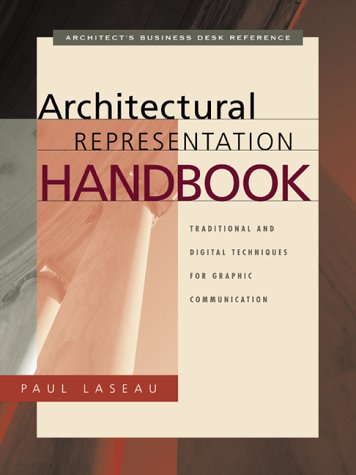
Architectural Representation Handbook: Traditional and Digital Techniques for Graphic Communication
📄 Viewing lite version
Full site ›
Book Details
Author(s)Paul Laseau
PublisherMcGraw-Hill Professional Publishing
ISBN / ASIN0070383146
ISBN-139780070383142
Sales Rank3,780,286
CategoryArchitecture
MarketplaceUnited States 🇺🇸
Description ▲
Apply media & techniques to fit any design task Architectural Representation Handbook Traditional and Digital Techniques for Graphic Communication Thanks to the impact of computer graphics on architecture, there are more architectural representation techniques, conventions, and styles than ever. Luckily, the Architectural Representation Handbook helps you make sense of it all. Not only does it give you a solid overview of these tools, but, just as importantly, it guides you toward the tools that will work best for any phase of your project. In this groundbreaking book, architect, designer, and prominent educator Paul Laseau covers the entire scope of architectural representation--traditional, new media, hybrid, and emerging--and their roles in design. The Architectural Representation Handbook brings showcase examples of representation into specific design contexts, giving architects, designers, and others a real sense of their variety, subtlety, and usefulness as tools for navigating the full spectrum of architecture. In one complete volume, you'll find a representation of the dimensions of architecture through a rich array of conventions and techniques from the conceptual to the perceptual, the concrete to the abstract, the personal to the public, the subjective to the objective. You'll also discover an extensive set of illustrations, organized in relation to the design activities of seeing, thinking, and communication--a "vocabulary" of architectural drawing. To maximize the potential of representation tools and techniques for your next design job, go with your best option of all: the Architectural Representation Handbook. ENDORSEMENTS FROM LEADING-EDGE FIRMS "I am enthusiastic aboutthe book. It is innovative to tie representation so intimately and so rigorously to design thinking. It has instant credibility because Paul wrote it." Tim White, FAMU "The strength of this book is that it approaches drawing from the viewpoint of its role in the design process--and also address the reader's natural inclination to look for useful and specific techniques." Frank Ching, author of Design Drawing and Architecture: Form, Space, and Order
More Books in Architecture
Dynamics of Pavement Structures
View
Compact City Series: Achieving Sustainable Urban Form
View
Invisible Acts of Power: Channeling Grace in Your Ever…
View
Movements in Green: Conceptual Landscape Gardening
View
Building After Auschwitz: Jewish Architecture and the …
View
The Four Elements of Architecture and Other Writings (…
View
Some Assembly Required
View
The Architecture of O'Neil Ford: Celebrating Place
View
Art/Women/California, 1950-2000: Parallels and Interse…
View