Search Books
Concise Encyclopedia of Com… Dielectric Materials for Wi…

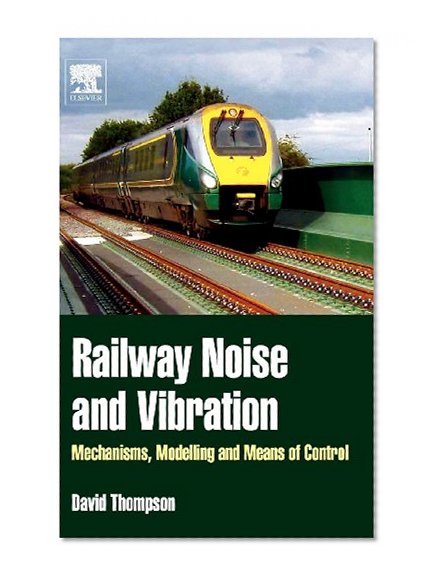
Railway Noise and Vibration: Mechanisms, Modelling and Means of Control

Author David Thompson
Publisher Elsevier Science
Category Technology & Engineering
📄 Viewing lite version Full site ›
🌎 Shop on Amazon — choose country
245.00 USD
🛒 Buy New on Amazon 🇺🇸 🏷 Buy Used — $113.66

✓ Usually ships in 24 hours

Share:
Book Details
ISBN / ASIN0080451470
ISBN-139780080451473
AvailabilityUsually ships in 24 hours
Sales Rank2,085,099
MarketplaceUnited States 🇺🇸

Description

Railways are an environmentally friendly means of transport well suited to modern society. However, noise and vibration are key obstacles to further development of the railway networks for high-speed intercity traffic, for freight and for suburban metros and light-rail. All too often noise problems are dealt with inefficiently due to lack of understanding of the problem.

This book brings together coverage of the theory of railway noise and vibration with practical applications of noise control technology at source to solve noise and vibration problems from railways. Each source of noise and vibration is described in a systematic way: rolling noise, curve squeal, bridge noise, aerodynamic noise, ground vibration and ground-borne noise, and vehicle interior noise.

• Theoretical modelling approaches are introduced for each source in a tutorial fashion
• Practical applications of noise control technology are presented using the theoretical models
• Extensive examples of application to noise reduction techniques are included

Railway Noise and Vibration is a hard-working reference and will be invaluable to all who have to deal with noise and vibration from railways, whether working in the industry or in consultancy or academic research.

David Thompson is Professor of Railway Noise and Vibration at the Institute of Sound and Vibration Research, University of Southampton. He has worked in the field of railway noise since 1980, with British Rail Research in Derby, UK, and TNO Institute of Applied Physics in the Netherlands before moving to Southampton in 1996. He was responsible for developing the TWINS software for predicting rolling noise.

* Discusses fully the theoretical background and practical workings of railway noise
* Includes the latest research findings, brought together in one place
* Forms an extended case study in the application of noise control techniques
Carpentry & Building Construction, Student Edition, 20…
View
The Electronics Dictionary for Technicians
View
Electronic Devices and Circuits (Merrill's Internation…
View
8086/8088, 80286, 80386 and 80486 Assembly Language Pr…
View
Digital and Analog Communication Systems
View
Introduction to Robotics
View
The Technology of Metallurgy
View
An Introduction to Transport Phenomena in Materials En…
View
Engineering graphics
View