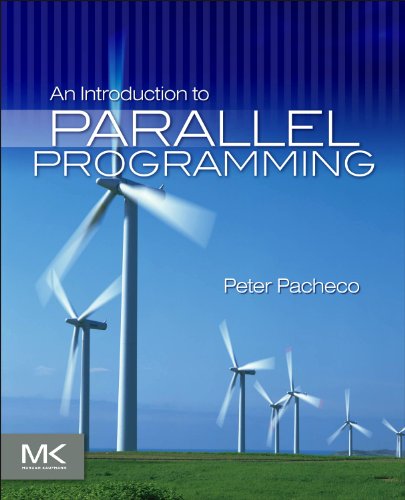
Author Peter Pacheco uses a tutorial approach to show students how to develop effective parallel programs with MPI, Pthreads, and OpenMP. The first undergraduate text to directly address compiling and running parallel programs on the new multi-core and cluster architecture, An Introduction to Parallel Programming explains how to design, debug, and evaluate the performance of distributed and shared-memory programs. User-friendly exercises teach students how to compile, run and modify example programs.
Key Features:- Takes a tutorial approach, starting with small programming examples and building progressively to more challenging examples
- Focuses on designing, debugging and evaluating the performance of distributed and shared-memory programs
- Explains how to develop parallel programs using MPI, Pthreads, and OpenMP programming models
How can we use this book to help us write parallel programs?
First, when you’re interested in high-performance, whether you’re writing serial or parallel programs, you need to know a little bit about the systems you’re working with--both hardware and software. In Chapter 2, we’ll give an overview of parallel hardware and software. In order to understand this discussion, it will be necessary to review some information on serial hardware and software. Much of the material in Chapter 2 won’t be needed when we’re getting started, so you might want to skim some of this material, and refer back to it occasionally when you’re reading later chapters.
The heart of the book is contained in Chapters 3 through 6. Chapters 3, 4, and 5 provide a very elementary introduction to programming parallel systems using C and MPI, Pthreads, and OpenMP, respectively. The only prerequisite for reading these chapters is a knowledge of C programming. We’ve tried to make these chapters independent of each other, and you should be able to read them in any order. However, in order to make them independent, we did find it necessary to repeat some material. So if you’ve read one of the three chapters, and you go on to read another, be prepared to skim over some of the material in the new chapter.
Chapter 6 puts together all we’ve learned in the preceding chapters, and develops two fairly large programs in both a shared- and a distributed-memory setting. However, it should be possible to read much of this even if you’ve only read one of Chapters 3, 4, or 5. The last chapter, Chapter 7, provides a few suggestions for further study on parallel programming.
Read a sample chapter from An Introduction to Parallel Programming