Search Books
Perl: The Complete Reference SQL Server Backup and Recov…

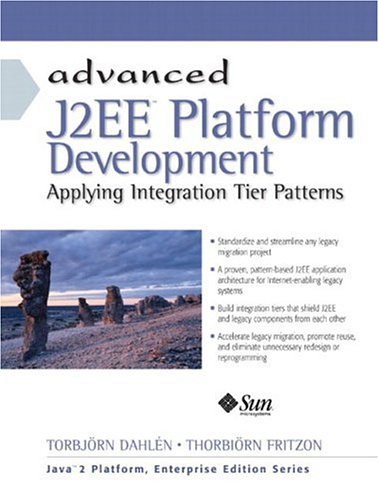
Advanced J2EE Platform Development: Applying Integration Tier Patterns

Author Torbjörn Dahlén, Thorbiörn Fritzon
Publisher Prentice Hall
Category Computers
📄 Viewing lite version Full site ›
🌎 Shop on Amazon — choose country
39.99 USD
🛒 Buy New on Amazon 🇺🇸 🏷 Buy Used — $0.01
Share:
Book Details
PublisherPrentice Hall
ISBN / ASIN0130449121
ISBN-139780130449122
Sales Rank9,783,124
CategoryComputers
MarketplaceUnited States 🇺🇸

Description

Enterprise applications, F. Scott Fitzgerald might have said if he had been a programmer, are not like ordinary software. He would have been right, too: Multi-tier applications are inherently more complex than traditional software, and are subject to their own special collection of bugbears. Advanced J2EE Platform Development explores the characteristics of real-world multi-tier software as implemented in Java 2 Enterprise Edition (J2EE), delivering a warts-and-all picture of the development environment as it's used for tying together user interfaces, business logic, databases, and--unusually among J2EE books, which usually treat this last part as an afterthought--legacy systems such as mainframes. This is a useful, eminently practical guide to J2EE software design.

Torbjörn Dahlen and Thorbjörn Fritzon do the software-engineering community a favor by championing the idea of a common domain model--a standardized idea of business entities (customers, products, and employees, for example) that is shared across all software components. The idea is that such a model makes it easier to re-use software and to validate deliverables against specifications. The authors go into great detail on putting together meaningful entity relationship diagrams, translating them into software objects, and integrating the lot. They use case studies--complete with lots of code listings--extensively, taking a bank as an illustrative example. --David Wall

Topics covered: Good software design practices for J2EE, particularly in situations in which there is a need to integrate with legacy systems. The authors advocate a common domain model helps isolate J2EE objects from the peculiarities of legacy systems, and discuss other strategies for making a clean migration to J2EE.

Windows XP, Vol. 1 (SELECT Series)
View
Internet Searching and Indexing: The Subject Approach
View
Control Problems in Industry: Proceedings from the SIA…
View
Open Source Systems Security Certification
View
Java: Data Structures and Programming
View
User-Centered Web Development
View
Query Processing in Database Systems (Topics in Inform…
View
Fundamentals of SQL Server 2005
View
Dreamweaver CS4: The Missing Manual (Spanish Edition)
View