New York Times Bestseller
One of our wisest and most clear-eyed economic thinkers offers a masterful narrative of the crisis and its lessons.
Many fine books on the financial crisis were first drafts of history—books written to fill the need for immediate understanding. Alan S. Blinder, esteemed Princeton professor, Wall Street Journal columnist, and former vice chairman of the Federal Reserve Board, held off, taking the time to understand the crisis and to think his way through to a truly comprehensive and coherent narrative of how the worst economic crisis in postwar American history happened, what the government did to fight it, and what we can do from here—mired as we still are in its wreckage.
With bracing clarity, Blinder shows us how the U.S. financial system, which had grown far too complex for its own good—and too unregulated for the public good—experienced a perfect storm beginning in 2007. Things started unraveling when the much-chronicled housing bubble burst, but the ensuing implosion of what Blinder calls the “bond bubble” was larger and more devastating. Some people think of the financial industry as a sideshow with little relevance to the real economy—where the jobs, factories, and shops are. But finance is more like the circulatory system of the economic body: if the blood stops flowing, the body goes into cardiac arrest. When America’s financial structure crumbled, the damage proved to be not only deep, but wide. It took the crisis for the world to discover, to its horror, just how truly interconnected—and fragile—the global financial system is. Some observers argue that large global forces were the major culprits of the crisis. Blinder disagrees, arguing that the problem started in the U.S. and was pushed abroad, as complex, opaque, and overrated investment products were exported to a hungry world, which was nearly poisoned by them.
The second part of the story explains how American and international government intervention kept us from a total meltdown. Many of the U.S. government’s actions, particularly the Fed’s, were previously unimaginable. And to an amazing—and certainly misunderstood—extent, they worked. The worst did not happen. Blinder offers clear-eyed answers to the questions still before us, even if some of the choices ahead are as divisive as they are unavoidable. After the Music Stopped is an essential history that we cannot afford to forget, because one thing history teaches is that it will happen again.
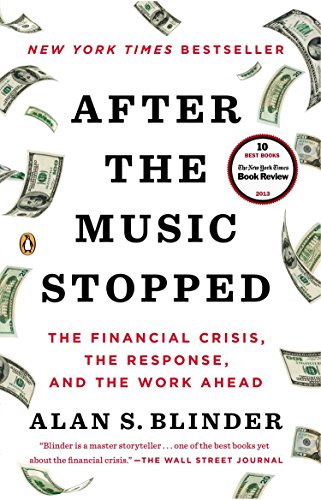
After the Music Stopped: The Financial Crisis, the Response, and the Work Ahead
📄 Viewing lite version
Full site ›
Book Details
Author(s)Blinder, Alan S.
PublisherPenguin Books
ISBN / ASIN014312448X
ISBN-139780143124481
AvailabilityIn Stock.
Sales Rank81,918
CategoryBusiness & Economics
MarketplaceUnited States 🇺🇸
Description ▲
Similar Products ▼
- Stress Test: Reflections on Financial Crises
- The Federal Reserve and the Financial Crisis
- House of Debt: How They (and You) Caused the Great Recession, and How We Can Prevent It from Happening Again
- On the Brink: Inside the Race to Stop the Collapse of the Global Financial System -- With Original New Material on the Five Year Anniversary of the Financial Crisis
- The Great Crash 1929
- Too Big to Fail: The Inside Story of How Wall Street and Washington Fought to Save the Financial System--and Themselves
- In FED We Trust: Ben Bernanke's War on the Great Panic
- Manias, Panics, and Crashes: A History of Financial Crises, Seventh Edition
- All the Devils Are Here: The Hidden History of the Financial Crisis
- The Shifts and the Shocks: What We've Learned--and Have Still to Learn--from the Financial Crisis
More Books in Business & Economics
Business Cycles and Forecasting
View
Development Economics: Its Position in the Present Sta…
View
Cost Systems Design
View
So You Want to Dance on Broadway
View
The Blueprint: Reviving Innovation, Rediscovering Risk…
View
Managing IT Outsourcing, Second Edition
View
Education and the Creation of Capital in the Early Ame…
View
Global Corruption Report 2005: Special Focus: Corrupti…
View
More Tales for Trainers: Using Stories and Metaphors t…
View