I don't know if people will ever be able to talk to animals the way Doctor Doolittle could, or whether animals will be able to talk back. Maybe science will have something to say about that. But I do know people can learn to "talk" to animals, and to hear what animals have to say, better than they do now. --From Animals in Translation
Why would a cow lick a tractor? Why are collies getting dumber? Why do dolphins sometimes kill for fun? How can a parrot learn to spell? How did wolves teach man to evolve? Temple Grandin draws upon a long, distinguished career as an animal scientist and her own experiences with autism to deliver an extraordinary message about how animals act, think, and feel. She has a perspective like that of no other expert in the field, which allows her to offer unparalleled observations and groundbreaking ideas.
People with autism can often think the way animals think, putting them in the perfect position to translate "animal talk." Grandin is a faithful guide into their world, exploring animal pain, fear, aggression, love, friendship, communication, learning, and, yes, even animal genius. The sweep of Animals in Translation is immense and will forever change the way we think about animals.
*includes a Behavior and Training Troubleshooting Guide
Among its provocative ideas, the book:
argues that language is not a requirement for consciousness--and that animals do have consciousness applies the autism theory of "hyper-specificity" to animals, showing that animals and autistic people are so sensitive to detail that they "can't see the forest for the trees"--a talent as well as a "deficit" explores the "interpreter" in the normal human brain that filters out detail, leaving people blind to much of the reality that surrounds them--a reality animals and autistic people see, sometimes all too clearlyexplains how animals have "superhuman" skills: animals have animal geniuscompares animals to autistic savants, declaring that animals may in fact be autistic savants, with special forms of genius that normal people do not possess and sometimes cannot even see examines how humans and animals use their emotions to think, to decide, and even to predict the future reveals the remarkable abilities of handicapped people and animals maintains that the single worst thing you can do to an animal is to make it feel afraid
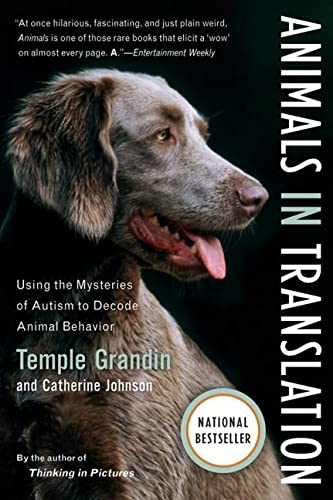
Animals in Translation: Using the Mysteries of Autism to Decode Animal Behavior (A Harvest Book)
📄 Viewing lite version
Full site ›
Book Details
Author(s)Temple Grandin
PublisherHarcourt
ISBN / ASIN0156031442
ISBN-139780156031448
AvailabilityIn Stock.
Sales Rank33,694
CategoryNature
MarketplaceUnited States 🇺🇸
Description ▲
Similar Products ▼
- Animals Make Us Human
- Temple Grandin's Guide to Working with Farm Animals: Safe, Humane Livestock Handling Practices for the Small Farm
- Thinking in Pictures, Expanded Edition: My Life with Autism
- The Autistic Brain
- Animals Make Us Human: Creating the Best Life for Animals
- Humane Livestock Handling: Understanding livestock behavior and building facilities for healthier animals
- Animal Restraint for Veterinary Professionals
- Clinical Laboratory Animal Medicine: An Introduction
- Some We Love, Some We Hate, Some We Eat: Why It's So Hard to Think Straight About Animals (P.S.)
- Unwritten Rules of Social Relationships: Decoding Social Mysteries Through the Unique Perspectives of Autism: New Edition with Author Updates
More Books in Nature
The Quest For The Eastern Cougar: Extinction or Surviv…
View
A Spring without Bees: How Colony Collapse Disorder Ha…
View
Inferno (Bill and Alice Wright Photography)
View
Protecting New Jersey's Environment: From Cancer Alley…
View
Finding the Line: ordinary encounters in nature's mirr…
View
North Sea Climate: Based on observations from ships an…
View
Parrots: Lovebird, Parakeet, Kea, Monk Parakeet, Amazo…
View
The Politics and Economics of Park Management
View
Ignoring the Apocalypse: Why Planning to Prevent Envir…
View
A Voice for Earth: American Writers Respond to the Ear…
View