While many transnational histories of the nuclear arms race have been written, Kate Brown provides the first definitive account of the great plutonium disasters of the United States and the Soviet Union.
In Plutopia, Brown draws on official records and dozens of interviews to tell the extraordinary stories of Richland, Washington and Ozersk, Russia-the first two cities in the world to produce plutonium. To contain secrets, American and Soviet leaders created plutopias--communities of nuclear families living in highly-subsidized, limited-access atomic cities. Fully employed and medically monitored, the residents of Richland and Ozersk enjoyed all the pleasures of consumer society, while nearby, migrants, prisoners, and soldiers were banned from plutopia--they lived in temporary "staging grounds" and often performed the most dangerous work at the plant. Brown shows that the plants' segregation of permanent and temporary workers and of nuclear and non-nuclear zones created a bubble of immunity, where dumps and accidents were glossed over and plant managers freely embezzled and polluted. In four decades, the Hanford plant near Richland and the Maiak plant near Ozersk each issued at least 200 million curies of radioactive isotopes into the surrounding environment--equaling four Chernobyls--laying waste to hundreds of square miles and contaminating rivers, fields, forests, and food supplies. Because of the decades of secrecy, downwind and downriver neighbors of the plutonium plants had difficulty proving what they suspected, that the rash of illnesses, cancers, and birth defects in their communities were caused by the plants' radioactive emissions. Plutopia was successful because in its zoned-off isolation it appeared to deliver the promises of the American dream and Soviet communism; in reality, it concealed disasters that remain highly unstable and threatening today.
An untold and profoundly important piece of Cold War history, Plutopia invites readers to consider the nuclear footprint left by the arms race and the enormous price of paying for it.
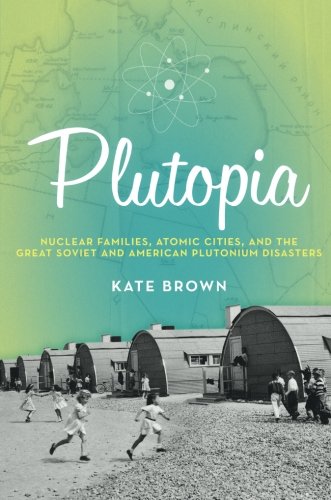
Plutopia: Nuclear Families, Atomic Cities, and the Great Soviet and American Plutonium Disasters
📄 Viewing lite version
Full site ›
Book Details
Author(s)Kate Brown
PublisherOxford University Press
ISBN / ASIN0190233109
ISBN-139780190233105
AvailabilityUsually ships in 24 hours
Sales Rank229,932
CategoryHistory
MarketplaceUnited States 🇺🇸
Description ▲
Similar Products ▼
- Power Lines: Phoenix and the Making of the Modern Southwest (Politics and Society in Modern America)
- A Tempest: Based on Shakespeare's 'The Tempest;' Adaptation for a Black Theatre
- The World Transformed: 1945 to the Present
- Gandhi: 'Hind Swaraj' and Other Writings Centenary Edition (Cambridge Texts in Modern Politics)
- Killing for Coal: America's Deadliest Labor War
- Collected Fictions
- Late Victorian Holocausts: El Niño Famines and the Making of the Third World
- The Periodic Table (Everyman's Library Contemporary Classics Series)
- American Environmental History: An Introduction (Columbia Guides to American History and Cultures)
- The Origins of the Urban Crisis: Race and Inequality in Postwar Detroit - Updated Edition (Princeton Classics)
More Books in History
Tutankhamen, Amenism, Atenism and Egyptian Monotheism,…
View
Barefoot on Crane Island: A Fond Reminiscence of Lake …
View
Critical Essays on Israeli Society, Religion, and Gove…
View
Flashpoint in Ukraine: How the US Drive for Hegemony R…
View
Militancy and Violence in West Africa (Contemporary Se…
View
The Confessions of Edward Isham: A Poor White Life of …
View
A Nation Transformed: England after the Restoration
View
Bunyan'S Devotional Works. the Spirit of Prayer: the S…
View