Human beings are primates, and primates are political animals. Our brains, therefore, are designed not just to hunt and gather, but also to help us get ahead socially, often via deception and self-deception. But while we may be self-interested schemers, we benefit by pretending otherwise. The less we know about our own ugly motives, the better - and thus we don't like to talk or even think about the extent of our selfishness. This is "the elephant in the brain." Such an introspective taboo makes it hard for us to think clearly about our nature and the explanations for our behavior. The aim of this book, then, is to confront our hidden motives directly - to track down the darker, unexamined corners of our psyches and blast them with floodlights. Then, once everything is clearly visible, we can work to better understand ourselves: Why do we laugh? Why are artists sexy? Why do we brag about travel? Why do we prefer to speak rather than listen?
Our unconscious motives drive more than just our private behavior; they also infect our venerated social institutions such as Art, School, Charity, Medicine, Politics, and Religion. In fact, these institutions are in many ways designed to accommodate our hidden motives, to serve covert agendas alongside their "official" ones. The existence of big hidden motives can upend the usual political debates, leading one to question the legitimacy of these social institutions, and of standard policies designed to favor or discourage them. You won't see yourself - or the world - the same after confronting the elephant in the brain.
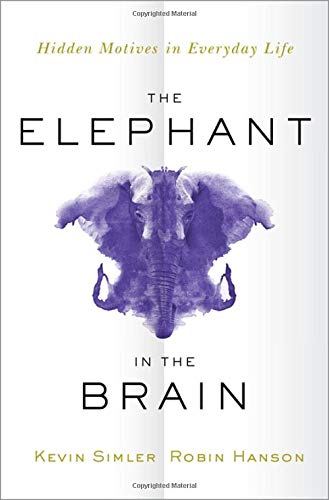
The Elephant in the Brain: Hidden Motives in Everyday Life
📄 Viewing lite version
Full site ›
Book Details
Author(s)Simler, Kevin
PublisherOxford University Press
ISBN / ASIN0190495995
ISBN-139780190495992
AvailabilityIn Stock.
Sales Rank38,057
MarketplaceUnited States 🇺🇸
Description ▲
Similar Products ▼
- Inadequate Equilibria: Where and How Civilizations Get Stuck
- The Case against Education: Why the Education System Is a Waste of Time and Money
- Stubborn Attachments: A Vision for a Society of Free, Prosperous, and Responsible Individuals
- Advice That Sticks: How to give financial advice that people will follow
- Cents and Sensibility: What Economics Can Learn from the Humanities
- Skin in the Game: Hidden Asymmetries in Daily Life
- The Age of Em: Work, Love, and Life when Robots Rule the Earth
- The Myth of the Rational Voter: Why Democracies Choose Bad Policies - New Edition
- Thinking in Bets: Making Smarter Decisions When You Don't Have All the Facts
- 21 Lessons for the 21st Century