"Left behind were hundreds of burned-out buildings, whole blocks that looked as though they had been bombed into oblivion." These words, written by the Washington Post's Leonard Downie Jr., do not describe a war zone but rather the nation's capital reeling in the wake of the riots of April 1968. In the devastating aftermath of Martin Luther King's assassination, a community already plagued by poor living conditions, unfair policing, and segregation broke into chaos.
These riots brought well-documented tragedy and heartbreak--not only among the families of those who lost their lives but also among those who lost their homes, possessions, jobs, and businesses. There was anger, fear, and anxiety throughout the city of Washington, DC, from the White House to the residential neighborhoods of the capital. There was an excruciating dilemma for President Lyndon Johnson. He was outraged by the violence in the streets, but he also keenly aware that African American citizens who joined the riots had legitimate grievances that his civil rights initiatives did little to address.
J. Samuel Walker's Most of 14th Street is Gone takes an in-depth look at the causes and consequences of the Washington, DC riots of 1968. It shows the conditions that existed in Washington, DC's low-income neighborhoods, setting the stage for the disorders that began after King's murder. It also traces the growing fears produced by the outbreaks of serious riots in many cities during the mid-1960s. The centerpiece of the book is a detailed account of the riots that raged in Washington, DC from the perspectives of rioters, victims, law enforcement officials, soldiers, and government leaders. The destruction was so extensive that parts of the city were described as "smoldering ruins block after block." Walker analyzes the reasons for the riots and the lessons that authorities drew from them. He also provides an overview of the struggle that the city of Washington, DC faced in recovering from the effects of the 1968 disorders. Finally, he considers why serious riots have been so rare in Washington, DC and other cities since 1968. Walker's timely and sensitive examination of a community, a city, and a country rocked by racial tension, violence, and frustration speaks not only to this nation's past but to its present.
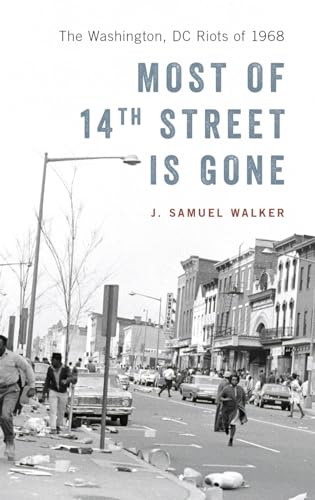
Most of 14th Street Is Gone: The Washington, DC Riots of 1968
📄 Viewing lite version
Full site ›
Book Details
Author(s)J. Samuel Walker
PublisherOxford University Press, USA
ISBN / ASIN0190844795
ISBN-139780190844790
AvailabilityOnly 4 left in stock (more on the way).
Sales Rank1,371
CategoryHardcover
MarketplaceUnited States 🇺🇸
Description ▲
Similar Products ▼
- Chocolate City: A History of Race and Democracy in the Nation's Capital
- A Nation on Fire: America in the Wake of the King Assassination
- The Color of Law: A Forgotten History of How Our Government Segregated America
- Dream City: Race, Power, and the Decline of Washington, D.C.
- Separate and Unequal: The Kerner Commission and the Unraveling of American Liberalism
- Race, Class, and Politics in the Cappuccino City
- The Guarded Gate: Bigotry, Eugenics and the Law That Kept Two Generations of Jews, Italians, and Other European Immigrants Out of America
- Empire of Mud: The Secret History of Washington, DC
- I Am Not Your Negro
- LBJ's 1968: Power, Politics, and the Presidency in America's Year of Upheaval