In a world of supercomputers, genetic engineering, and fiber optics, technological creativity is ever more the key to economic success. But why are some nations more creative than others, and why do some highly innovative societies--such as ancient China, or Britain in the industrial revolution--pass into stagnation?
Beginning with a fascinating, concise history of technological progress, Mokyr sets the background for his analysis by tracing the major inventions and innovations that have transformed society since ancient Greece and Rome. What emerges from this survey is often surprising: the classical world, for instance, was largely barren of new technology, the relatively backward society of medieval Europe bristled with inventions, and the period between the Reformation and the Industrial Revolution was one of slow and unspectacular progress in technology, despite the tumultuous developments associated with the Voyages of Discovery and the Scientific Revolution.
What were the causes of technological creativity? Mokyr distinguishes between the relationship of inventors and their physical environment--which determined their willingness to challenge nature--and the social environment, which determined the openness to new ideas. He discusses a long list of such factors, showing how they interact to help or hinder a nation's creativity, and then illustrates them by a number of detailed comparative studies, examining the differences between Europe and China, between classical antiquity and medieval Europe, and between Britain and the rest of Europe during the industrial revolution. He examines such aspects as the role of the state (the Chinese gave up a millennium-wide lead in shipping to the Europeans, for example, when an Emperor banned large ocean-going vessels), the impact of science, as well as religion, politics, and even nutrition. He questions the importance of such commonly-cited factors as the spill-over benefits of war, the abundance of natural resources, life expectancy, and labor costs.
Today, an ever greater number of industrial economies are competing in the global market, locked in a struggle that revolves around technological ingenuity. The Lever of Riches, with its keen analysis derived from a sweeping survey of creativity throughout history, offers telling insights into the question of how Western economies can maintain, and developing nations can unlock, their creative potential.
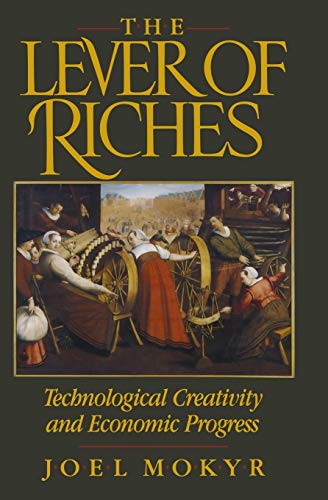
The Lever of Riches: Technological Creativity and Economic Progress
📄 Viewing lite version
Full site ›
Book Details
Author(s)Mokyr, Joel
PublisherOxford University Press
ISBN / ASIN0195074777
ISBN-139780195074772
AvailabilityIn Stock.
Sales Rank735,514
CategoryBusiness & Economics
MarketplaceUnited States 🇺🇸
Description ▲
More Books in Business & Economics
Business Cycles and Forecasting
View
Development Economics: Its Position in the Present Sta…
View
Cost Systems Design
View
So You Want to Dance on Broadway
View
The Blueprint: Reviving Innovation, Rediscovering Risk…
View
Managing IT Outsourcing, Second Edition
View
Education and the Creation of Capital in the Early Ame…
View
Global Corruption Report 2005: Special Focus: Corrupti…
View
More Tales for Trainers: Using Stories and Metaphors t…
View