The Indian Ocean remains the least studied of the world's geographic regions. Yet there have been major cultural exchanges across its waters and around its shores from the third millennium B.C.E. to the present day. Historian Edward A. Alpers explores the complex issues involved in cultural exchange in the Indian Ocean Rim region over the course of this long period of time by combining a historical approach with the insights of anthropology, art history, ethnomusicology, and geography.
The Indian Ocean witnessed several significant diasporas during the past two millennia, including migrations of traders, indentured laborers, civil servants, sailors, and slaves throughout the entire basin. Persians and Arabs from the Gulf came to eastern Africa and Madagascar as traders and settlers, while Hadramis dispersed from south Yemen as traders and Muslim teachers to the Comoro Islands, Zanzibar, South India, and Indonesia. Southeast Asians migrated to Madagascar, and Chinese dispersed from Southeast Asia to the Mascarene Islands to South Africa.
Alpers also explores the cultural exchanges that diasporas cause, telling stories of identity and cultural transformation through language, popular religion, music, dance, art and architecture, and social organization. For example, architectural and decorative styles in eastern Africa, the Red Sea, the Hadramaut, the Persian Gulf, and western India reflect cultural interchanges in multiple directions. Similarly, the popular musical form of taarab in Zanzibar and coastal East Africa incorporates elements of Arab, Indian, and African musical traditions, while the characteristic frame drum (ravanne) of séga, the widespread Afro-Creole dance of the Mascarene and Seychelles Islands, probably owes its ultimate origins to Arabia by way of Mozambique.
The Indian Ocean in World History also discusses issues of trade and production that show the long history of exchange throughout the Indian Ocean world; politics and empire-building by both regional and European powers; and the role of religion and religious conversion, focusing mainly on Islam, but also mentioning Hinduism, Buddhism and Christianity. Using a broad geographic perspective, the book includes references to connections between the Indian Ocean world and the Americas. Moving into the twentieth and twenty-first centuries, Alpers looks at issues including the new configuration of colonial territorial boundaries after World War I, and the search for oil reserves.
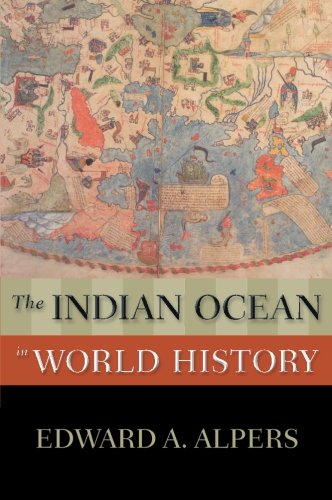
The Indian Ocean in World History (New Oxford World History)
📄 Viewing lite version
Full site ›
Book Details
Author(s)Edward A. Alpers
PublisherOxford University Press
ISBN / ASIN0195337875
ISBN-139780195337877
AvailabilityUsually ships in 24 hours
Sales Rank640,291
CategoryHistory
MarketplaceUnited States 🇺🇸
Description ▲
Similar Products ▼
- Genghis Khan and the Making of the Modern World
- Traditional China in Asian and World History (Key Issues in Asian Studies} (Key Issues in Asian Studies)
- From the Ruins of Empire: The Revolt Against the West and the Remaking of Asia
- Global India Circa 100 CE South Asia in Early World History
- Japan and Imperialism, 1853-1945
- Sea of Poppies: A Novel (The Ibis Trilogy)
- Malik Ambar: Power and Slavery across the Indian Ocean (The World in a Life Series)
- The Pirates of Somalia: Inside Their Hidden World
- In an Antique Land: History in the Guise of a Traveler's Tale
- The Silk Road in World History (New Oxford World History)
More Books in History
The Bet, and Other Stories
View
Pakistan and the Bomb: Public Opinion and Nuclear Opti…
View
Writing National Histories: Western Europe Since 1800
View
Empire in Eclipse
View
Monks and Laymen in Byzantium, 843-1118
View
The Wilmington and Western Railroad (Images of Rail: D…
View
Black Sailor, White Navy: Racial Unrest in the Fleet d…
View
Feasibility of Laser Power Transmission to a High-Alti…
View
The Democratic Republic: 1801-1815
View