Both those who study crime and those who fight it agree that crime is not spread evenly across city landscapes. Rather, clusters of crime--a few "hot spots"--host a vastly disproportionate amount of criminal activity. Even within the most crime-ridden neighborhoods, crime concentrates at a few locations while other areas remain relatively crime-free. So if police focus their limited resources at these problem places-a practice known as hot spots policing-they will be better positioned to lower citywide crime rates, and do it more efficiently.
In Policing Problem Places, Anthony A. Braga and David L. Weisburd demonstrate that hot spots policing is a powerful and cost-effective approach to crime prevention. While putting police officers where crime happens most is an old and well-established idea, in practice it is often avoided or not properly implemented. Braga and Weisburd draw on rigorous scientific evidence to show how police officers should use problem-oriented policing and situational crime-prevention techniques to address the place dynamics, situations, and characteristics that cause a spot to be "hot." But the benefits of hot spots policing do not end with conserving public dollars and police resources. Illustrating how policing problem places can benefit police-community relations, especially in minority neighborhoods where residents have long suffered from high crime and poor police service, Braga and Weisburd show how police can make efforts to develop positive and collaborative relationships with residents and avoid the indiscriminant enforcement tactics that undermine the legitimacy of the police.
A vital resource for police departments everywhere, Policing Problem Places offers a blueprint for rethinking what police should do and how they should do it.
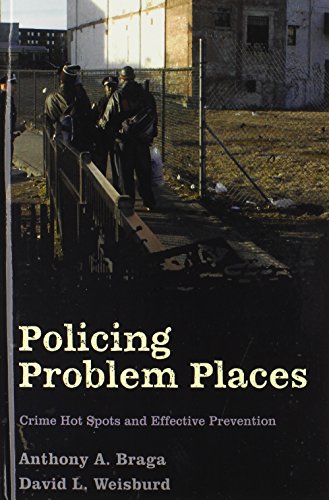
Policing Problem Places: Crime Hot Spots and Effective Prevention (Studies in Crime and Public Policy)
📄 Viewing lite version
Full site ›
Book Details
Author(s)Anthony A. Braga, David L. Weisburd
PublisherOxford University Press
ISBN / ASIN0195341961
ISBN-139780195341966
AvailabilityUsually ships in 24 hours
Sales Rank1,072,232
CategorySocial Science
MarketplaceUnited States 🇺🇸
Description ▲
Similar Products ▼
- Police Innovation: Contrasting Perspectives (Cambridge Studies in Criminology)
- The Criminology of Place: Street Segments and Our Understanding of the Crime Problem
- The Police in America: An Introduction
- The Worst Hard Time: The Untold Story of Those Who Survived the Great American Dust Bowl
- Place Matters: Criminology for the Twenty-First Century
- The Police in America: An Introduction
- The War on Cops: How the New Attack on Law and Order Makes Everyone Less Safe
- Don't Shoot: One Man, A Street Fellowship, and the End of Violence in Inner-City America
- The City That Became Safe: New York's Lessons for Urban Crime and Its Control (Studies in Crime and Public Policy)
- Criminology: The Core
More Books in Social Science
Introduction to the Sociology of Development
View
The Career Mystique: Cracks in the American Dream
View
Three Studies on Egyptian Feasts and their Chronologic…
View
American People Of Austrian Descent, including: Arnold…
View
World Wrestling Entertainment Championships, including…
View
Fetish Artists, including: John Willie, Robert Bishop …
View
Fictional Irish People, including: Leopold Bloom, Arte…
View
Sound Alliances: Indigenous Peoples, Cultural Politics…
View
Andean Entrepreneurs: Otavalo Merchants and Musicians …
View