Although scientists have discovered many fundamental physiological and behavioral mechanisms that comprise the stress response, most of current knowledge is based on laboratory experiments using domesticated or captive animals. Scientists are only beginning, however, to understand how stress impacts wild animals - by studying the nature of the stressful stimuli that animals in their natural environments have adapted to for survival, and what the mechanisms that allow that survival might be. This book summarizes, for the first time, several decades of work on understanding stress in natural contexts. The aim is two-fold. The first goal of this work is to place modern stress research into an evolutionary context. The stress response clearly did not evolve to cause disease, so that studying how animals use the stress response to survive in the wild should provide insight into why mechanisms evolved the way that they did. The second goal is to provide predictions on how wild animals might cope with the Anthropocene, the current period of Earth's history characterized by the massive human remodeling of habitats on a global scale. Conservation of species will rely upon how wild animals use their stress response to successfully cope with human-created stressors.
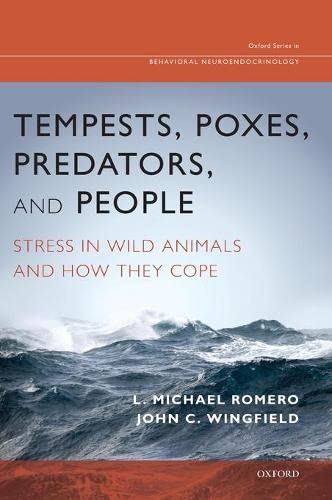
Tempests, Poxes, Predators, and People: Stress in Wild Animals and How They Cope (Oxford Series in Behavioral Neuroendocrinology)
📄 Viewing lite version
Full site ›
190
USD
🛒 Buy New on Amazon 🇺🇸
Book Details
Author(s)L.Michael Romero, John C. Wingfield,
PublisherOxford University Press
ISBN / ASIN0195366697
ISBN-139780195366693
Sales Rank2,450,677
CategoryAnimal welfare
MarketplaceUnited States 🇺🇸
Description ▲
More Books in Animal welfare
With Dogs at the Edge of Life
View
Excellence Beyond Compliance: Enhancing Animal Welfare…
View
Free Willy
View
Dear World, See What I See: My Vegan Path (Revised Edi…
View
The Animal Estate: The English and Other Creatures in …
View
Pieces of My Heart
View
Free Willy
View
Free Willy 2: The Adventure Home (Movie Tie in)
View