Half a century later, for the first time in European history, the Jews of France were accorded equal rights of citizenship in the wake of the revolution. From that time on, Vital writes in his encyclopedic history of Jews in early-modern Europe, secularism replaced the former hierarchy of ghetto leaders and rabbinical authority. Able to move more or less freely in the larger society, Jews no longer had to band together for protection, and in short order many of them played important roles in finance, government, and industry. Reaction to their rise was swift: with it came an increase in anti-Semitism and militant nationalism throughout Europe, opposition from both right and left. Their communities now weakened, Jews were ever more vulnerable to attacks by their enemies. These tendencies would culminate in Holocaust, a nightmare of history that, Vital shows, was decades in the making. --Gregory McNamee
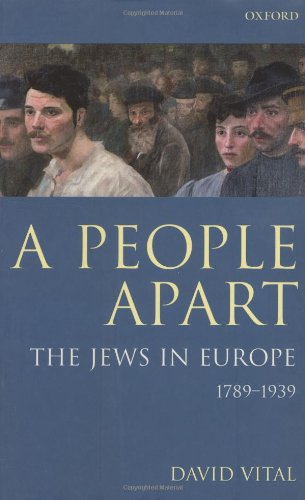
A People Apart: The Jews in Europe, 1789-1939 (Oxford History of Modern Europe)
📄 Viewing lite version
Full site ›
Book Details
Author(s)David Vital
PublisherOxford University Press
ISBN / ASIN0198219806
ISBN-139780198219804
Sales Rank1,543,616
MarketplaceUnited States 🇺🇸
Description ▲
In 1744, at the height of the War of the Austrian Succession, Empress Maria Therese came to believe that the Jews of Prague were plotting against her, in league with Austria's Prussian enemies. She decided accordingly to expel every member of the city's long-established Jewish community--"a brutal sanction," Anglo-Israeli historian David Vital notes, that "would have put an entire population on to the roads of Europe to march through lands in which they were highly unlikely to be allowed to settle in search of one in which they might." Maria Therese relented eventually, but the Jews of her empire were reminded once again of their precarious position, always potential victims of a ruler's whim.