This is the first full study of how people refer to entities in natural discourse. It contributes to the understanding of both linguistic diversity and the cognitive underpinnings of language and it provides a framework for further research in both fields. Andrej Kibrik focuses on the way specific entities are mentioned in natural discourse, during which about every third word usually depends on referential choice. He considers reference as an overt representation of underlying cognitive processes and combines a theoretically-oriented cognitive approach with empirically-based cross-linguistic analysis. He begins by introducing the cognitive approach to discourse analysis and by examining the relationship between discourse studies and linguistic typology. He discusses reference as a linguistic phenomenon, in connection with the traditional notions of deixis, anaphora, givenness, and topicality, and describes the way his theoretical approach is centered on notions of referent activation in working memory. He argues that the speaker is responsible for the shape of discourse and that referential expressions should be understood as choices made by speakers rather than as puzzles to be solved by addressees.
Kibrik examines the cross-linguistic aspects of reference and the typology of referential devices, including referring expressions per se, such as free and bound pronouns, and referential aids that help to tell apart the concurrently activated entities. This discussion is based on the data from about 200 languages from around the world. He then proposes a comprehensive model of referential choice, in which he draws on concepts from cognitive linguistics, psycholinguistics, cognitive psychology, and cognitive neuroscience, and applies this to Russian and English. He also draws together his empirical analyses in order to examine what light his analysis of discourse can shed on the way information is processed in working memory. In the final part of the book Andrej Kibrik offers a wider perspective, including deixis, referential aspects of gesticulation and signed languages.
This pioneering work will interest linguists and cognitive scientists interested in discourse, reference, typology, and the operations of working memory in linguistic communication.
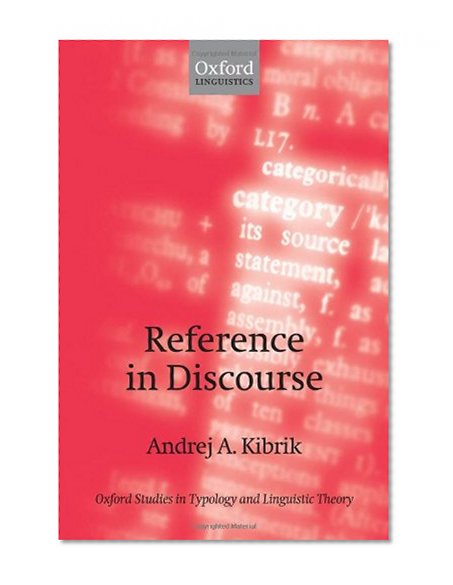
Reference in Discourse (Oxford Studies in Typology and Linguistic Theory)
📄 Viewing lite version
Full site ›
Book Details
Author(s)Andrej A. Kibrik
PublisherOxford University Press
ISBN / ASIN0199215804
ISBN-139780199215805
AvailabilityUsually ships in 24 hours
Sales Rank2,833,840
CategoryLanguage Arts & Disciplines
MarketplaceUnited States 🇺🇸
Description ▲
More Books in Language Arts & Disciplines
Meaning and Grammar - 2nd Edition: An Introduction to …
View
Challenges for Arabic Machine Translation (Natural Lan…
View
Cyberpragmatics (Pragmatics & Beyond New Series)
View
Pierre Bourdieu: A Critical Introduction to Media and …
View
Tools for Matching Readers to Texts: Research-Based Pr…
View
The Development of Language (5th Edition)
View
Medical Writing in Early Modern English (Studies in En…
View
Language Death: Factual and Theoretical Explorations w…
View