The sixteenth and seventeenth centuries witnessed such fervent investigations of the natural world that the period has been called the "Scientific Revolution." New ideas and discoveries not only redefined what human beings believed, knew, and could do, but also forced them to redefine themselves with respect to the strange new worlds revealed by ships and scalpels, telescopes and microscopes, experimentation and contemplation. Explanatory systems were made, discarded, and remade by some of the best-known names in the entire history of science--Copernicus, Galileo, Newton--and by many others less recognized but no less important. In this Very Short Introduction Lawrence M. Principe explores the exciting developments in the sciences of the stars (astronomy, astrology, and cosmology), the sciences of earth (geography, geology, hydraulics, pneumatics), the sciences of matter and motion (alchemy, chemistry, kinematics, physics), the sciences of life (medicine, anatomy, biology, zoology), and much more. The story is told from the perspective of the historical characters themselves, emphasizing their background, context, reasoning, and motivations, and dispelling well-worn myths about the history of science.
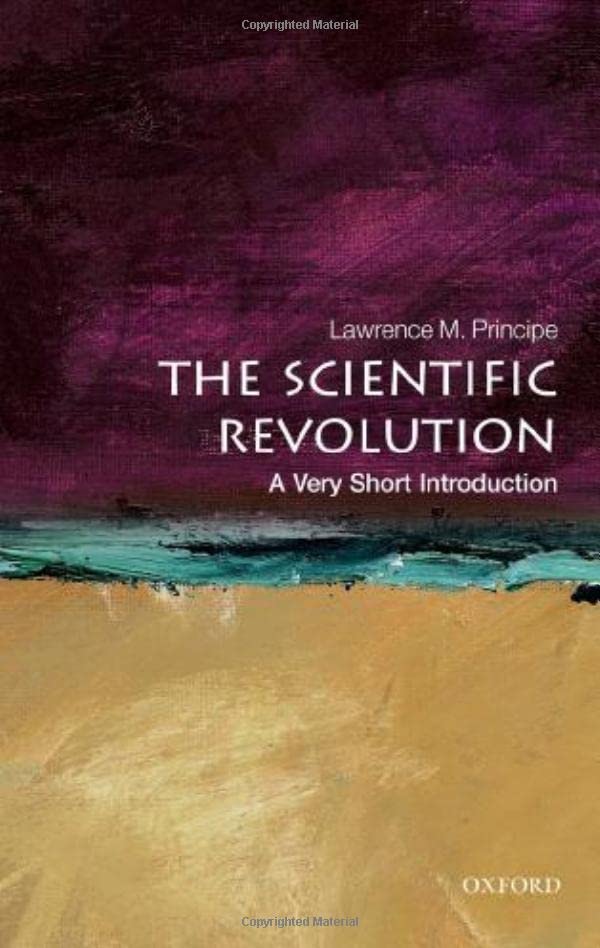
Scientific Revolution: A Very Short Introduction
📄 Viewing lite version
Full site ›
11.95
USD
🛒 Buy New on Amazon 🇺🇸
Book Details
Author(s)Lawrence M. Principe,
PublisherOxford University Press
ISBN / ASIN0199567417
ISBN-139780199567416
Sales Rank302,488
CategoryScience
MarketplaceUnited States 🇺🇸
Description ▲
More Books in Science
Low and High Dielectric Constant Materials and Their A…
View
From Biology to Sociopolitics: Conceptual Continuity i…
View
Reviews of Plasma Chemistry: Volume 2
View
Application of Short-Term Bioassays in the Fractionati…
View
The Molecular Immunology of Complex Carbohydrates - 2 …
View
Structure, Function and Biogenesis of Energy Transfer …
View
The Interacting Boson Model (Cambridge Monographs on M…
View
Heavy Quark Physics (Cambridge Monographs on Particle …
View
An Introduction to Theoretical Chemistry
View