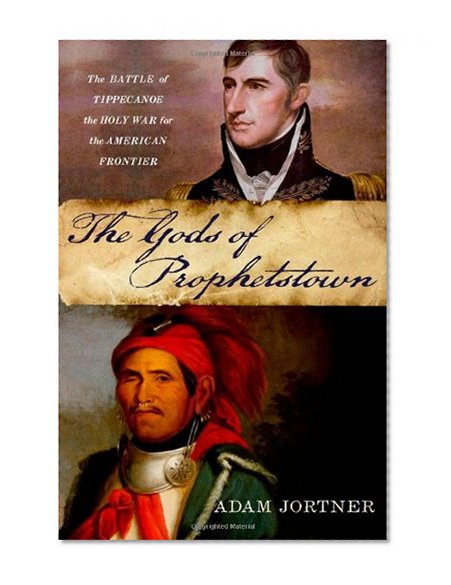
The Gods of Prophetstown: The Battle of Tippecanoe and the Holy War for the American Frontier
📄 Viewing lite version
Full site ›
Book Details
Author(s)Adam Jortner
PublisherOxford University Press
ISBN / ASIN0199765294
ISBN-139780199765294
AvailabilityUsually ships in 24 hours
Sales Rank827,180
CategoryHistory
MarketplaceUnited States 🇺🇸
Description ▲
Amazon Exclusive: Author Q & A with Adam JortnerAdam JortnerQ: Did America really start a "holy war" in the early 19th century? A: Just like today, a lot of Americans in the early 19th century thought God had a plan for the United States; they saw how the U.S. won the Revolution against all odds, and they understood it as the will of God--as providence. And at that time, there were a number of politicians who said we have a providential destiny to bring our citizens more liberty--to spread our civilization across the continent. That's what led to a war against Canada and the Native Americans, the War of 1812, which almost destroyed the country. Q: This was a war against one religion in particular, wasn't it? A: There was a holy man of the Shawnee nation who took the name Tenskwatawa, which roughly means "The Open Door." After 1804, he carries a message to the Native Americans across the frontier, but especially in the Ohio Valley. And his message is that the Master of Life, the great being who had created the world and made all the peoples of the Americas, had returned to guide his people on a new path towards independence and self-sufficiency. American officials worried about this religion because Tenskwatawa provided an alternative leadership for Native Americans; he refused to sell land and he refused to accept the perfidy of the Americans. Q: Most of us only know William Henry Harrison as the guy who died after only being president for thirty days. Tell us more about him. A: This all takes place thirty years before Harrison becomes President; in 1800, he was the governor of Indiana Territory, which he turned into his personal fiefdom. It's probably the least democratic place in the U.S. He appointed his own Senate, he exploited loopholes to make sure that his friends got elected, and he basically disenfranchised voters he thought were not going to vote for his handpicked candidates. And on top of that, he expands slavery in Indiana. And he's constantly reminding people that his way of doing things is the providential way; it's what freedom is and it's what God wants. Q: What happened at the Battle of Tippecanoe? A: A lot of pain for not much gain. Harrison's forces get trapped in an early morning skirmish outside the Prophet's city. There was a prolonged firefight, and Harrison's troops took the heavier losses, but eventually the Prophet's soldiers withdrew and abandoned their city. Harrison burns the city to the ground--but he immediately retreats, because he didn’t bring enough troops or materiel to secure the victory. And Tenskwatawa reoccupies the position and rebuilds the town. Q: Did the Battle of Tippecanoe cause the War of 1812? A: In part. Harrison was immediately censured by political enemies in Indiana and in Washington, D.C. for starting an unnecessary war. He's even investigated by Congress--but he saves himself by joining this push for a broader war against all the Northwest Indians and Canada. Q: Most Americans know almost nothing about the War of 1812? Why is that? What should we remember about it? A: I think we don't remember it because we lost. But in some ways, it's more important to remember because this was a war that politicians claimed was divine and would be easy to win. That's a cautionary tale. And I think it's important to remember as an example of the ways in which religious zealotry and political power can interact, on both sides of this conflict, and that's another cautionary tale.
More Books in History
The Bet, and Other Stories
View
Pakistan and the Bomb: Public Opinion and Nuclear Opti…
View
Writing National Histories: Western Europe Since 1800
View
Empire in Eclipse
View
Monks and Laymen in Byzantium, 843-1118
View
The Wilmington and Western Railroad (Images of Rail: D…
View
Black Sailor, White Navy: Racial Unrest in the Fleet d…
View
Feasibility of Laser Power Transmission to a High-Alti…
View
The Democratic Republic: 1801-1815
View