Ideal for social science courses in game theory and research methods, Introduction to Game Theory: A Behavioral Approach explains basic game theory concepts--up to and including Bayesian Nash equilibrium--using results from laboratory experiments that examine how real people behave in standard modeled games. Working from the premise that the crux of game theory lies in thinking logically about a problem and formulating research questions based on theory, author Kenneth C. Williams takes a nontechnical, behavioral approach that is accessible to students with minimal math skills.
Incorporating a wide range of experiments with diverse designs, Introduction to Game Theory is also enhanced by numerous pedagogical features:
* Extensive problem sets, in-class experiments, and sample exams
* Numerical examples for all of the exercises
* Key terms and concepts for behavioral game theory--which differ from those for standard game theory--and a glossary
* Supplemental lecture material and Internet resources--online games, videos, lectures, problems sets, exams, and experiments that students can participate in
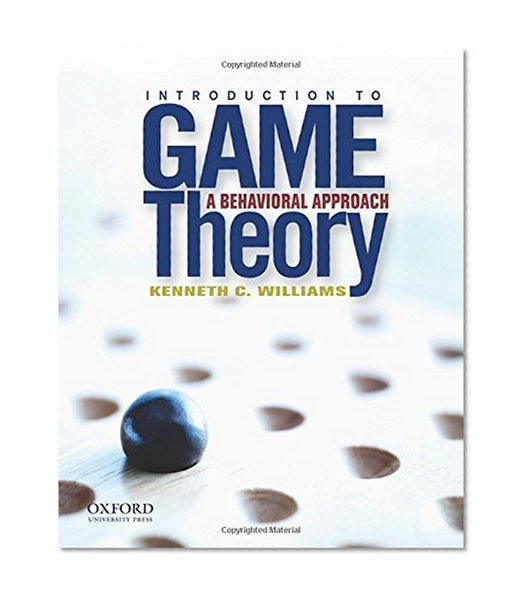
Introduction to Game Theory: A Behavioral Approach
📄 Viewing lite version
Full site ›
Book Details
Author(s)Kenneth C. Williams
PublisherOxford University Press
ISBN / ASIN0199837392
ISBN-139780199837397
AvailabilityUsually ships in 24 hours
Sales Rank1,437,629
CategoryBusiness & Economics
MarketplaceUnited States 🇺🇸
Description ▲
More Books in Business & Economics
Business Cycles and Forecasting
View
Development Economics: Its Position in the Present Sta…
View
Cost Systems Design
View
So You Want to Dance on Broadway
View
The Blueprint: Reviving Innovation, Rediscovering Risk…
View
Managing IT Outsourcing, Second Edition
View
Education and the Creation of Capital in the Early Ame…
View
Global Corruption Report 2005: Special Focus: Corrupti…
View
More Tales for Trainers: Using Stories and Metaphors t…
View