Thoroughly revised and updated, the third edition of Intuitive Biostatistics: A Nonmathematical Guide to Statistical Thinking retains and refines the core perspectives of the previous editions: a focus on how to interpret statistical results rather than on how to analyze data, minimal use of equations, and a detailed review of assumptions and common mistakes.
With its engaging and conversational tone, this unique book provides a clear introduction to statistics for undergraduate and graduate students in a wide range of fields and also serves as a statistics refresher for working scientists. It is especially useful for those students in health-science related fields who have no background in biostatistics.
CONTENTS
Part A: Introducing Statistics 1. Statistics and Probability Are Not Intuitive 2. The Complexities of Probability 3. From Sample to Population Part B: Confidence Intervals 4. Confidence Interval of a Proportion 5. Confidence Interval of Survival Data 6. Confidence Interval of Counted Data Part C: Continuous Variables 7. Graphing Continuous Data 8. Types of Variables 9. Quantifying Scatter 10. The Gaussian Distribution 11. The Lognormal Distribution and Geometric Mean12. Confidence Interval of a Mean 13. The Theory of Confidence Intervals14. Error Bars PART D: P Values and Significance 15. Introducing P Values 16. Statistical Significance and Hypothesis Testing17. Relationship Between Confidence Intervals and Statistical Significance 18. Interpreting a Result That Is Statistically Significant 19. Interpreting a Result That Is Not Statistically Significant 20. Statistical Power21. Testing for Equivalence or NoninferiorityPART E: Challenges in Statistics 22. Multiple Comparisons Concepts 23. The Ubiquity of Multiple Comparison24. Normality Tests25. Outliers 26. Choosing a Sample SizePART F: Statistical Tests 27. Comparing Proportions28. Case-Control Studies29. Comparing Survival Curves 30. Comparing Two Means: Unpaired t Test31. Comparing Two Paired Groups32. Correlation PART G: Fitting Models to Data 33. Simple Linear Regression34. Introducing Models 35. Comparing Models 36. Nonlinear Regression37. Multiple Regression 38. Logistic and Proportional Hazards RegressionPART H The Rest of Statistics 39. Analysis of Variance 40. Multiple Comparison Tests After ANOVA 41. Nonparametric Methods42. Sensitivity and Specificity and Receiver-Operator Characteristic Curves 43. Meta-analysisPART I Putting It All Together 44. The Key Concepts of Statistics45. Statistical Traps to Avoid46. Capstone Example 47. Review Problems 48. Answers to Review Problems
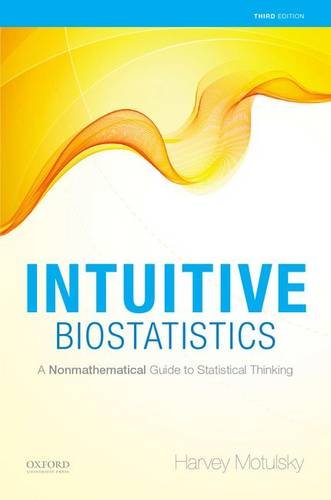
Intuitive Biostatistics: A Nonmathematical Guide to Statistical Thinking, 3rd edition
📄 Viewing lite version
Full site ›
Book Details
Author(s)Motulsky, Harvey
PublisherOxford University Press
ISBN / ASIN0199946647
ISBN-139780199946648
AvailabilityIn Stock.
Sales Rank578,691
CategoryMedical
MarketplaceUnited States 🇺🇸
Description ▲
Similar Products ▼
- Fundamentals of Biostatistics
- Epidemiology for Public Health Practice (Friis, Epidemiology for Public Health Practice)
- Essential Biostatistics: A Nonmathematical Approach
- Biostatistics: A Foundation for Analysis in the Health Sciences
- Proposal Writing for Clinical Nursing and DNP Projects
- Epidemiology: with STUDENT CONSULT Online Access (Gordis, Epidemiology)
- Environmental Health: From Global to Local (Public Health/Environmental Health)
- Health Behavior: Theory, Research, and Practice (Jossey-Bass Public Health)
- Biostatistics For Dummies
- Principles of Biostatistics (with CD-ROM)
More Books in Medical
Short-Term Bioassays in the Analysis of Complex Enviro…
View
Regulating Medical Work: Formal and Informal Controls …
View
Research and Development in Mental Health: Theory, Fra…
View
The AHA Clinical Cardiac Consult (The 5-Minute Consult…
View
Brain Dopaminergic Systems: Imaging with Positron Tomo…
View
Imaging & Intervention in Cardiology (Developments in …
View
Nuclear Medicine Therapy
View
Breast Imaging (Breast Disease, 13)
View
Handbook of Systemic Drug Treatment in Dermatology
View
Essential Biochemistry and Genetics for Medicine
View