In When Buildings Speak,Anthony Alofsin explores the rich yet often overlooked architecture of the late Austro-Hungarian Empire and its successor states. He shows that several different styles emerged in this milieu during the late nineteenth and early twentieth centuries. Moreover, he contends that each of these styles communicates to us in a manner resembling language and its particular means of expression.Â
           Covering a wide range of buildings—from national theaters to crematoria, apartment buildings to warehouses, and sanatoria to postal savings banks—Alofsin proposes a new way of interpreting this language. He calls on viewers to read buildings in two ways: through their formal elements and through their political, social, and cultural contexts. By looking through Alofsin’s eyes, readers can see how myriad nations sought to express their autonomy by tapping into the limitless possibilities of art and architectural styles. And such architecture can still speak very powerfully to us today about the contradictory issues affecting parts of the former Habsburg Empire.
Â
 “The book itself as a production is spectacular.â€â€”David Dunster, Architectural Review
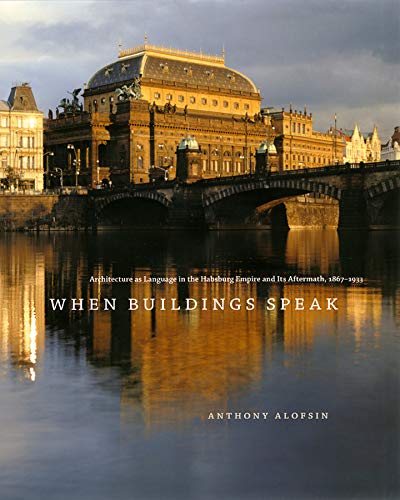
When Buildings Speak: Architecture As Language in the Habsburg Empire and Its Aftermath, 1867-1933
📄 Viewing lite version
Full site ›
45
USD
🛒 Buy New on Amazon 🇺🇸
Book Details
Author(s)Anthony Alofsin,
PublisherUniversity Of Chicago Press
ISBN / ASIN0226015076
ISBN-139780226015071
Sales Rank2,459,968
CategoryArchitecture
MarketplaceUnited States 🇺🇸
Description ▲
More Books in Architecture
Dynamics of Pavement Structures
View
Compact City Series: Achieving Sustainable Urban Form
View
Invisible Acts of Power: Channeling Grace in Your Ever…
View
Movements in Green: Conceptual Landscape Gardening
View
Building After Auschwitz: Jewish Architecture and the …
View
The Four Elements of Architecture and Other Writings (…
View
Some Assembly Required
View
The Architecture of O'Neil Ford: Celebrating Place
View
Art/Women/California, 1950-2000: Parallels and Interse…
View