The Nicomachean Ethics is one of Aristotle’s most widely read and influential works. Ideas central to ethics—that happiness is the end of human endeavor, that moral virtue is formed through action and habituation, and that good action requires prudence—found their most powerful proponent in the person medieval scholars simply called “the Philosopher.” Drawing on their intimate knowledge of Aristotle’s thought, Robert C. Bartlett and Susan D. Collins have produced here an English-language translation of the Ethics that is as remarkably faithful to the original as it is graceful in its rendering.
Aristotle is well known for the precision with which he chooses his words, and in this elegant translation his work has found its ideal match. Bartlett and Collins provide copious notes and a glossary providing context and further explanation for students, as well as an introduction and a substantial interpretive essay that sketch central arguments of the work and the seminal place of Aristotle’s Ethics in his political philosophy as a whole.
The Nicomachean Ethics has engaged the serious interest of readers across centuries and civilizations—of peoples ancient, medieval, and modern; pagan, Christian, Muslim, and Jewish—and this new edition will take its place as the standard English-language translation.
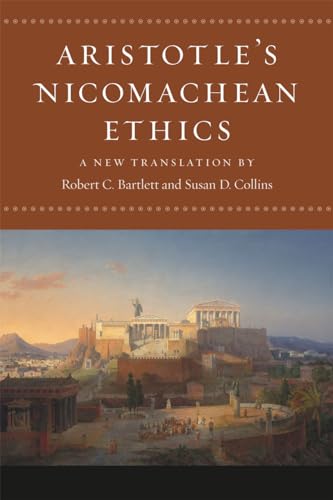
Aristotle's Nicomachean Ethics
📄 Viewing lite version
Full site ›
Book Details
Author(s)Aristotle
PublisherUniversity of Chicago Press
ISBN / ASIN0226026752
ISBN-139780226026756
AvailabilityIn Stock.
Sales Rank15,620
MarketplaceUnited States 🇺🇸
Description ▲
Similar Products ▼
- Aristotle's "Politics": Second Edition
- 4 Texts on Socrates: Plato's Euthyphro, Apology of Socrates, Crito and Aristophanes' Clouds, Revised Edition
- The Book of Chuang Tzu (Penguin Classics)
- Republic (Hackett Classics)
- On the Good Life (Penguin Classics)
- Euripides V: Bacchae, Iphigenia in Aulis, The Cyclops, Rhesus (The Complete Greek Tragedies)
- Equality By Default: An Essay On Modernity As Confinement (Crosscurrents)
- Confessions (Oxford World's Classics)
- The Iliad
- Utilitarianism