Since the creation of minority-dominated congressional districts eight years ago, the Supreme Court has condemned the move as akin to "political apartheid," while many African-American leaders argue that such districts are required for authentic representation.
In the most comprehensive treatment of the subject to date, David Canon shows that the unintended consequences of black majority districts actually contradict the common wisdom that whites will not be adequately represented in these areas. Not only do black candidates need white votes to win, but this crucial "swing" vote often decides the race. And, once elected, even the black members who appeal primarily to black voters usually do a better job than white members of walking the racial tightrope, balancing the needs of their diverse constituents.
Ultimately, Canon contends, minority districting is good for the country as a whole. These districts not only give African Americans a greater voice in the political process, they promote a politics of commonality a biracial politics rather than a politics of difference.
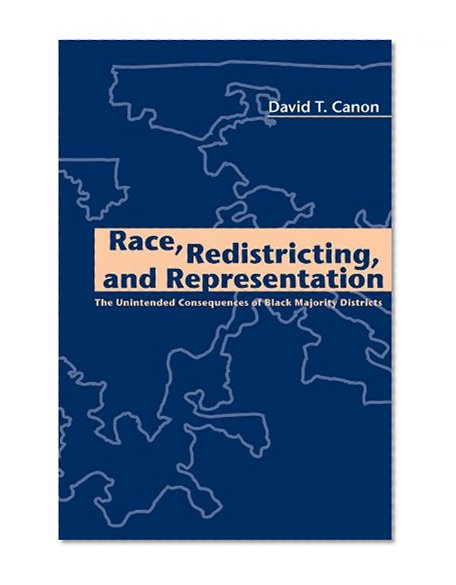
Race, Redistricting, and Representation: The Unintended Consequences of Black Majority Districts (American Politics and Political Economy Series)
📄 Viewing lite version
Full site ›
Book Details
Author(s)David T. Canon
PublisherUniversity Of Chicago Press
ISBN / ASIN0226092712
ISBN-139780226092713
AvailabilityUsually ships in 24 hours
Sales Rank491,313
CategoryPolitical Science
MarketplaceUnited States 🇺🇸
Description ▲
More Books in Political Science
Joyous Greetings: The First International Women's Move…
View
In the Realm of Hungry Ghosts: Close Encounters with A…
View
Public Management: Thinking and Acting in Three Dimens…
View
Understanding NAFTA: Mexico, Free Trade, and the New N…
View
Comparative Approaches to Program Planning
View
Negotiating Bioethics: The Governance of UNESCO's Bioe…
View
The New Spymasters: Inside the Modern World of Espiona…
View
Ecosystem Services from Agriculture and Agroforestry: …
View