The Great American Recession resulted in the loss of eight million jobs between 2007 and 2009. More than four million homes were lost to foreclosures. Is it a coincidence that the United States witnessed a dramatic rise in household debt in the years before the recession—that the total amount of debt for American households doubled between 2000 and 2007 to $14 trillion? Definitely not. Armed with clear and powerful evidence, Atif Mian and Amir Sufi reveal in House of Debt how the Great Recession and Great Depression, as well as the current economic malaise in Europe, were caused by a large run-up in household debt followed by a significantly large drop in household spending.
Though the banking crisis captured the public’s attention, Mian and Sufi argue strongly with actual data that current policy is too heavily biased toward protecting banks and creditors. Increasing the flow of credit, they show, is disastrously counterproductive when the fundamental problem is too much debt. As their research shows, excessive household debt leads to foreclosures, causing individuals to spend less and save more. Less spending means less demand for goods, followed by declines in production and huge job losses. How do we end such a cycle? With a direct attack on debt, say Mian and Sufi. More aggressive debt forgiveness after the crash helps, but as they illustrate, we can be rid of painful bubble-and-bust episodes only if the financial system moves away from its reliance on inflexible debt contracts. As an example, they propose new mortgage contracts that are built on the principle of risk-sharing, a concept that would have prevented the housing bubble from emerging in the first place.
Thoroughly grounded in compelling economic evidence, House of Debt offers convincing answers to some of the most important questions facing the modern economy today: Why do severe recessions happen? Could we have prevented the Great Recession and its consequences? And what actions are needed to prevent such crises going forward?
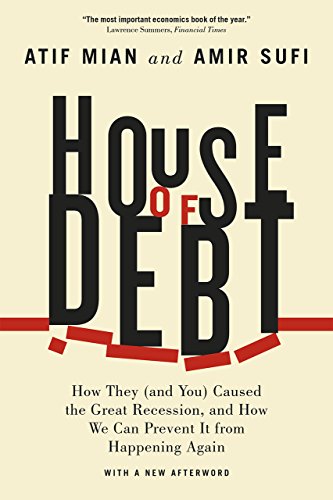
House of Debt: How They (and You) Caused the Great Recession, and How We Can Prevent It from Happening Again
📄 Viewing lite version
Full site ›
Book Details
Author(s)Mian, Atif
PublisherUniversity of Chicago Press
ISBN / ASIN022627165X
ISBN-139780226271651
AvailabilityIn Stock.
Sales Rank133,083
CategoryBusiness & Economics
MarketplaceUnited States 🇺🇸
Description ▲
Similar Products ▼
- Urban Economics
- Macroeconomics
- After the Music Stopped: The Financial Crisis, the Response, and the Work Ahead
- Microeconomic Theory: Basic Principles and Extensions
- The Shifts and the Shocks: What We've Learned--and Have Still to Learn--from the Financial Crisis
- Too Big to Fail: The Inside Story of How Wall Street and Washington Fought to Save the Financial System--and Themselves
- Urban Economics, 8th Edition
- Crashed: How a Decade of Financial Crises Changed the World
- Introductory Econometrics: A Modern Approach - Standalone Book
- The Bankers' New Clothes: What's Wrong with Banking and What to Do about It - Updated Edition
More Books in Business & Economics
Business Cycles and Forecasting
View
Development Economics: Its Position in the Present Sta…
View
Cost Systems Design
View
So You Want to Dance on Broadway
View
The Blueprint: Reviving Innovation, Rediscovering Risk…
View
Managing IT Outsourcing, Second Edition
View
Education and the Creation of Capital in the Early Ame…
View
Global Corruption Report 2005: Special Focus: Corrupti…
View
More Tales for Trainers: Using Stories and Metaphors t…
View