Search Books
Principles of Mineral Proce… Molecular Dynamics, Volume …

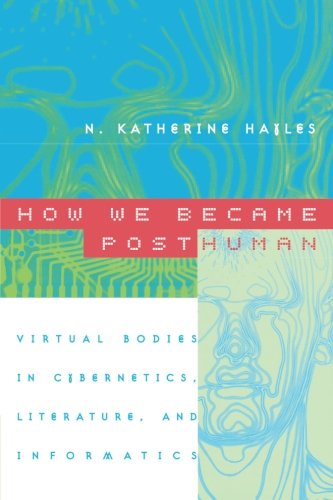
How We Became Posthuman: Virtual Bodies in Cybernetics, Literature, and Informatics

Author N. Katherine Hayles
Publisher University Of Chicago Press
Category Science
📄 Viewing lite version Full site ›
🌎 Shop on Amazon — choose country
15.65 22.50 USD
🛒 Buy New on Amazon 🇺🇸 🏷 Buy Used — $8.66

✓ Usually ships in 24 hours

Share:
Book Details
ISBN / ASIN0226321460
ISBN-139780226321462
AvailabilityUsually ships in 24 hours
Sales Rank426,303
CategoryScience
MarketplaceUnited States 🇺🇸

Description

The title of this scholarly yet remarkably accessible slice of contemporary cultural history has a whiff of paradox about it: what can it mean, exactly, to say that we humans have become something other than human? The answer, Katherine Hayles explains, lies not in ourselves but in our tools. Ever since the invention of electronic computers five decades ago, these powerful new machines have inspired a shift in how we define ourselves both as individuals and as a species.

Hayles tracks this shift across the history of avant-garde computer theory, starting with Norbert Weiner and other early "cyberneticists," who were the first to systematically explore the similarities between living and computing systems. Hayles's study ends with artificial-life specialists, many of whom no longer even bother to distinguish between life forms and computers. Along the way she shows these thinkers struggling to reconcile their traditional, Western notions of human identity with the unsettling, cyborg directions in which their own work seems to be leading humanity.

This is more than just the story of a geek elite, however. Hayles looks at cybernetically inspired science fiction by the likes of Philip K. Dick, William Gibson, and Neal Stephenson to show how the larger culture grapples with the same issues that dog the technologists. She also draws lucidly on her own broad grasp of contemporary philosophy both to contextualize those issues and to contend with them herself. The result is a fascinating introduction--and a valuable addition--to one of the most important currents in recent intellectual history. --Julian Dibbell

Low and High Dielectric Constant Materials and Their A…
View
From Biology to Sociopolitics: Conceptual Continuity i…
View
Reviews of Plasma Chemistry: Volume 2
View
Application of Short-Term Bioassays in the Fractionati…
View
The Molecular Immunology of Complex Carbohydrates - 2 …
View
Structure, Function and Biogenesis of Energy Transfer …
View
The Interacting Boson Model (Cambridge Monographs on M…
View
Heavy Quark Physics (Cambridge Monographs on Particle …
View
An Introduction to Theoretical Chemistry
View