In this classic work of sociology, Doug McAdam presents a political-process model that explains the rise and decline of the black protest movement in the United States. Moving from theoretical concerns to empirical analysis, he focuses on the crucial role of three institutions that foster protest: black churches, black colleges, and Southern chapters of the NAACP. He concludes that political opportunities, a heightened sense of political efficacy, and the development of these three institutions played a central role in shaping the civil rights movement. In his new introduction, McAdam revisits the civil rights struggle in light of recent scholarship on social movement origins and collective action.
"[A] first-rate analytical demonstration that the civil rights movement was the culmination of a long process of building institutions in the black community." Raymond Wolters, Journal of American History
"A fresh, rich, and dynamic model to explain the rise and decline of the black insurgency movement in the United States." James W. Lamare, Annals of the American Academy of Political and Social Science
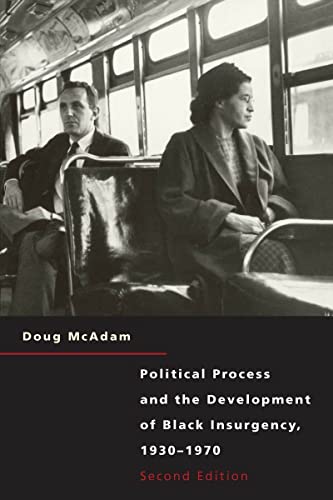
Political Process and the Development of Black Insurgency, 1930-1970, 2nd Edition
📄 Viewing lite version
Full site ›
33
USD
🛒 Buy New on Amazon 🇺🇸
Book Details
Author(s)Doug McAdam,
PublisherThe University Of Chicago Press
ISBN / ASIN0226555534
ISBN-139780226555539
Sales Rank331,753
CategoryPolitical Science
MarketplaceUnited States 🇺🇸
Description ▲
More Books in Political Science
The Millennium Development Goals and Beyond: Internati…
View
Transnational Networks in Regional Integration: Govern…
View
Forensic Psychophysiology Using the Polygraph: Scienti…
View
Gender, Islam and Democracy in Indonesia (ASAA Women i…
View
E-Governance: A Change Management Tool
View
Shop Floor Bargaining and the State: Historical and Co…
View
Red State Uprising: How to Take Back America
View
A Community Health Approach to the Assessment of Infan…
View
Foreign Aid and Landmine Clearance: Governance, Politi…
View