Throughout human history, people have imagined inanimate objects to have intelligence, language, and even souls. In our secular societies today, we still willingly believe that nonliving objects have lives of their own as we find ourselves interacting with computers and other equipment. In On the Animation of the Inorganic, Spyros Papapetros examines ideas about simulated movement and inorganic life during and after the turn of the twentieth century—a period of great technical innovation whose effects continue to reverberate today.
Exploring key works of art historians such as Aby Warburg, Wilhelm Worringer, and Alois Riegl, as well as architects and artists like Fernand Léger, Mies van der Rohe, and Salvador DalÃ, Papapetros tracks the evolution of the problem of animation from the fin de siècle through the twentieth century. He argues that empathy—the ability to identify with objects of the external world—was repressed by twentieth-century modernist culture, but it returned, projected onto inorganic objects such as machines, automobiles, and crystalline skyscrapers. These modern artifacts, he demonstrates, vibrated with energy, life, and desire of their own and had profound effects on people. Subtle and insightful, this book will change how we view modernist art, architecture, and their histories.
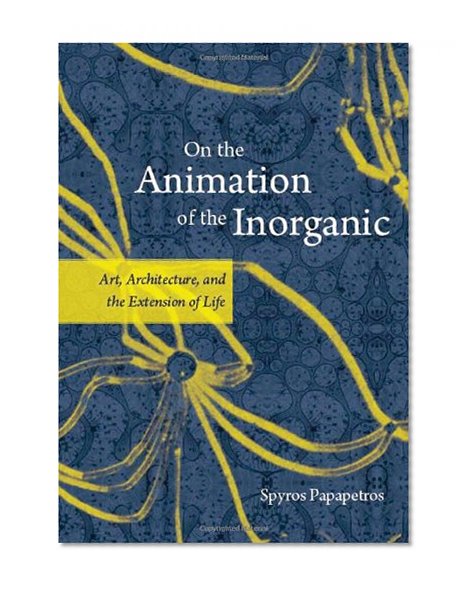
On the Animation of the Inorganic: Art, Architecture, and the Extension of Life
📄 Viewing lite version
Full site ›
Book Details
Author(s)Spyros Papapetros
PublisherUniversity Of Chicago Press
ISBN / ASIN0226645681
ISBN-139780226645681
AvailabilityUsually ships in 24 hours
Sales Rank1,222,560
CategoryArt
MarketplaceUnited States 🇺🇸
Description ▲
More Books in Art
The Osbick Bird
View
British Watercolours: 1750-1880
View
The Wizard of Oz (BFI Film Classics)
View
Legend of Korra: The Art of the Animated Series Book T…
View
Handmade in India: A Geographic Encyclopedia of India …
View
Correspondence Course: An Epistolary History of Carole…
View
Writing About the Humanities (3rd Edition)
View
The New Testament and Other Early Christian Writings: …
View