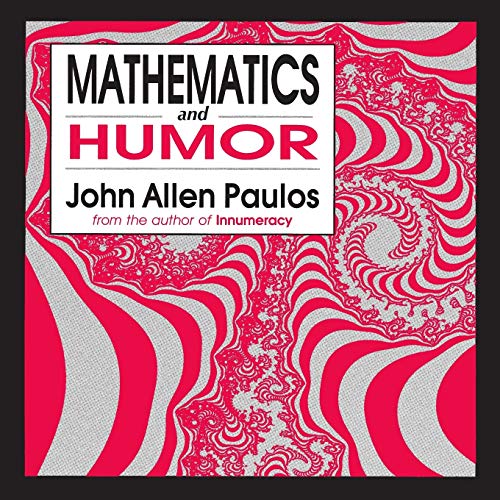
John Allen Paulos cleverly scrutinizes the mathematical structures of jokes, puns, paradoxes, spoonerisms, riddles, and other forms of humor, drawing examples from such sources as Rabelais, Shakespeare, James Beattie, René Thom, Lewis Carroll, Arthur Koestler, W. C. Fields, and Woody Allen.
"Jokes, paradoxes, riddles, and the art of non-sequitur are revealed with great perception and insight in this illuminating account of the relationship between humor and mathematics."—Joseph Williams, New York Times
"'Leave your mind alone,' said a Thurber cartoon, and a really complete and convincing analysis of what humour is might spoil all jokes forever. This book avoids that danger. What it does. . .is describe broadly several kinds of mathematical theory and apply them to throw sidelights on how many kinds of jokes work."—New Scientist
"Many scholars nowadays write seriously about the ludicrous. Some merely manage to be dull. A few—like Paulos—are brilliant in an odd endeavor."—Los Angeles Times Book Review
Mathematics and Humor
📄 Viewing lite version
Full site ›
Book Details
Author(s)Paulos, John Allen
PublisherUniversity Of Chicago Press
ISBN / ASIN0226650251
ISBN-139780226650258
AvailabilityIn Stock.
Sales Rank731,616
CategoryMathematics
MarketplaceUnited States 🇺🇸
Description ▲
More Books in Mathematics
Collins Primary Maths: Year 1 Bk.2
View
Collins Primary Maths: Year 2 Bk.2
View
Maths Plus: Bk.2
View
Spark Island: KS2 National Tests Maths
View
KS3 Maths (Test Practice)
View
Pupil Book 3B (Collins New Primary Maths)
View
Collins New Primary Maths – Pupil Book 5C
View
Year 9 Pupil Book 3 (Levels 6-8) (New Maths Frameworki…
View
Student Book Foundation 1: Foundation 1: Edexcel Modul…
View