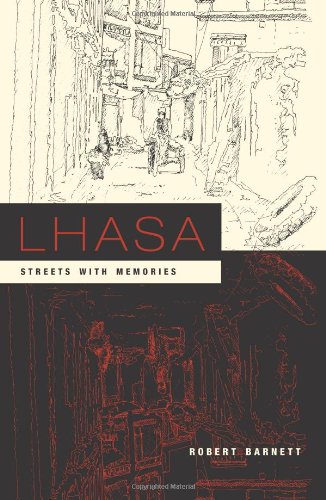
There are many Lhasas. One is a grid of uniform boulevards lined with plush hotels, all-night bars, and blue-glass-fronted offices. Another is a warren of alleyways that surround a seventh-century temple built to pin down a supine demoness. A web of Stalinist, rectangular blocks houses the new nomenklatura. Crumbling mansions, once home to noble ministers, famous lovers, nationalist spies, and covert revolutionaries, now serve as shopping malls and faux-antique hotels. Each embodiment of the city partakes of the others' memories, whispered across time and along the city streets.
In this imaginative new work, Robert Barnett offers a powerful and lyrical exploration of a city long idealized, disregarded, or misunderstood by outsiders. Looking to its streets and stone, Robert Barnett presents a searching and unforgettable portrait of Lhasa, its history, and its illegibility. His book not only offers itself as a manual for thinking about contemporary Tibet but also questions our ways of thinking about foreign places.
Barnett juxtaposes contemporary accounts of Tibet, architectural observations, and descriptions by foreign observers to describe Lhasa and its current status as both an ancient city and a modern Chinese provincial capital. His narrative reveals how historical layering, popular memory, symbolism, and mythology constitute the story of a city. Besides the ancient Buddhist temples and former picnic gardens of the Tibetan capital, Lhasa describes the urban sprawl, the harsh rectangular structures, and the geometric blue-glass tower blocks that speak of the anxieties of successive regimes intent upon improving on the past. In Barnett's excavation of the city's past, the buildings and the city streets, interwoven with his own recollections of unrest and resistance, recount the story of Tibet's complex transition from tradition to modernity and its painful history of foreign encounters and political experiment.