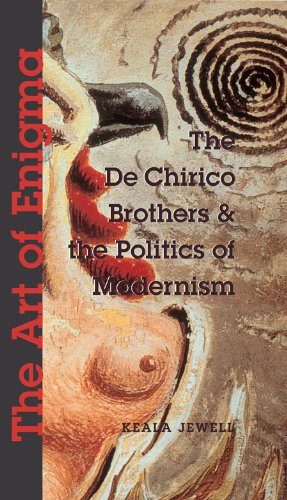
In this interdisciplinary book, Keala Jewell reunites Giorgio de Chirico (1888–1978) with his brother, Alberto Savinio (1891–1952), a prolific writer and painter who has been kept at the margins of the discussion of Surrealism and, more generally, the culture politics of twentieth-century Italy. Yet as Jewell demonstrates, the brothers worked together during their formative years in Munich and Paris and always shared, on the one hand, a drive to salvage Mediterranean myth and history and, on the other, a deep involvement with art’s power to shape cultural identity and authority.
Rather than looking for a key to unlock the secrets of the brothers’ recurrent use of dislocated spaces and bizarre hybrid figures, Jewell focuses on assessing the issues of identity and mastery put at stake in the haunting enigmas that characterize their paintings and writings. Deeply impressed by Nietzsche, she argues, they believed the "human" is inherently unstable and must be constantly "rewoven" with analogies and metaphors seized from empowering states of being.
Jewell’s approach to the de Chirico brothers breaks new ground, not only because it brings them together as artists and writers but also because it sets the brothers within the context of myth, history, and Italian culture politics, instead of French surrealism and its aesthetic and psychoanalytic theories. Further, Jewell’s strong readings of little-known paintings and notoriously difficult texts like Giorgio de Chirico’s Ebdòmero will expand and diversify the sources used in modernist studies.