For many years, law enforcement administrators, government officials, and researchers have explored the possibility of professionalizing law enforcement agencies and their officers. Some have called for mandatory college education requirements while others have argued for the formation of a national police force. In 1979, police practitioners from various law enforcement executive organizations met to develop a process to professionalize police agencies by instituting standards covering the wide range of police functions. The Commission on Accreditation for Law Enforcement Agencies, Inc. (CALEA) was born. This book describes the results of a study that evaluated the impact of CALEA accreditation on specific personnel administration practices in municipal police departments. The author compares accredited and non-accredited departments for personnel practices including procedures for officer selection, promotion, and the integration of formal education requirements.
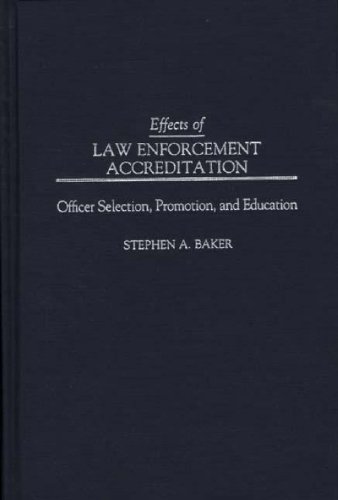
Effects of Law Enforcement Accreditation: Officer Selection, Promotion, and Education
📄 Viewing lite version
Full site ›
Book Details
Author(s)Stephen A. Baker
PublisherPraeger
ISBN / ASIN0275953114
ISBN-139780275953119
AvailabilityUsually ships in 24 hours
Sales Rank13,252,964
CategoryPolitical Science
MarketplaceUnited States 🇺🇸
Description ▲
More Books in Political Science
The Millennium Development Goals and Beyond: Internati…
View
Transnational Networks in Regional Integration: Govern…
View
Forensic Psychophysiology Using the Polygraph: Scienti…
View
Gender, Islam and Democracy in Indonesia (ASAA Women i…
View
E-Governance: A Change Management Tool
View
Shop Floor Bargaining and the State: Historical and Co…
View
Red State Uprising: How to Take Back America
View
A Community Health Approach to the Assessment of Infan…
View
Foreign Aid and Landmine Clearance: Governance, Politi…
View
The Limits of Culture: Islam and Foreign Policy (Belfe…
View