After the 1994 genocide in Rwanda, victims, perpetrators, and the country as a whole struggled to deal with the legacy of the mass violence. The government responded by creating a new version of a traditional grassroots justice system called gacaca. Bert Ingelaere, based on his observation of two thousand gacaca trials, offers a comprehensive assessment of what these courts set out to do, how they worked, what they achieved, what they did not achieve, and how they affected Rwandan society.
Weaving together vivid firsthand recollections, interviews, and trial testimony with systematic analysis, Ingelaere documents how the gacaca shifted over time from confession to accusation, from restoration to retribution. He precisely articulates the importance of popular conceptions of what is true and just. Marked by methodological sophistication, extraordinary evidence, and deep knowledge of Rwanda, this is an authoritative, nuanced, and bittersweet account of one of the most important experiments in transitional justice after mass violence.
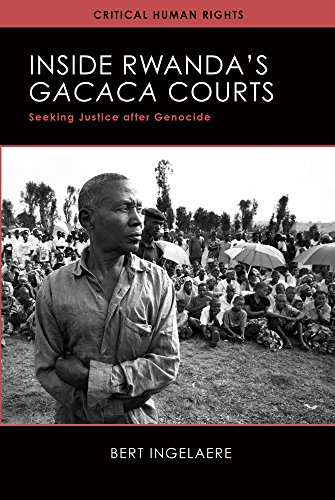
Inside Rwanda's /Gacaca/ Courts: Seeking Justice after Genocide (Critical Human Rights)
📄 Viewing lite version
Full site ›
44.27
USD
🛒 Buy New on Amazon 🇺🇸
Book Details
Author(s)Bert Ingelaere,
PublisherUniversity of Wisconsin Press
ISBN / ASIN0299309703
ISBN-139780299309701
Sales Rank2,389,104
CategoryHistory
MarketplaceUnited States 🇺🇸
Description ▲
More Books in History
The Bet, and Other Stories
View
Pakistan and the Bomb: Public Opinion and Nuclear Opti…
View
Writing National Histories: Western Europe Since 1800
View
Empire in Eclipse
View
Monks and Laymen in Byzantium, 843-1118
View
The Wilmington and Western Railroad (Images of Rail: D…
View
Black Sailor, White Navy: Racial Unrest in the Fleet d…
View
Feasibility of Laser Power Transmission to a High-Alti…
View
The Democratic Republic: 1801-1815
View