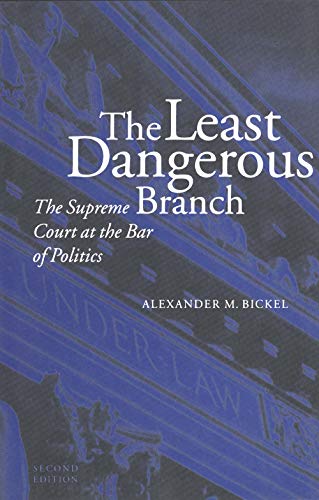
The Least Dangerous Branch: The Supreme Court at the Bar of Politics
📄 Viewing lite version
Full site ›
Book Details
Author(s)Bickel, Alexander M.
PublisherYale University Press
ISBN / ASIN0300032994
ISBN-139780300032994
AvailabilityIn Stock.
Sales Rank86,567
CategoryLaw
MarketplaceUnited States 🇺🇸
Description ▲
This classic book on the role of the United States Supreme Court traces the history of the Court, assessing the merits of various decisions along the way. Alexander Bickel begins with Marbury v. Madison, which he says give shaky support to judicial review, and concludes with the school desegregation cases of 1954, which he uses to show the extent and limits of the Court’s power. In this way he accomplishes his stated purpose: “to have the Supreme Court’s exercise of judicial review better understood and supported and more sagaciously used.” The book now includes a new foreword by Harry H. Wellington. Alexander Mordecai Bickel (1924-1974) was one of the most influential constitutional commentators of the twentieth century. Bickel’s most distinctive contribution to constitutional law was to stress what he called “the passive virtues” of judicial decision-making – the refusal to decide cases on substantive grounds if narrower grounds exist to decide the case. Bickel viewed “private ordering” and the voluntary working-out of problems as generally preferable to legalistic solutions. In his books Bickel attacked the Warren Court for what he saw as its misuse of history, shoddy reasoning, and sometimes arbitrary results. Bickel thought that the Warren Court’s two most important lines of decision, Brown v. Board of Education and Baker v. Carr, did not produce the results the Court had intended. In his book The Least Dangerous Branch, Bickel coined the term counter-majoritarian difficulty to describe his view that judicial review stands in tension with democratic theory. Bickel envisioned the Supreme Court as playing a statesman-like role in national controversies, engaging in dialogue with the other branches of government. Thus he did not see the Court as a purely passive body, but as one which should lead public opinion, albeit carefully.
Similar Products ▼
- Democracy and Distrust: A Theory of Judicial Review (Harvard Paperbacks)
- The Most Dangerous Branch: Inside the Supreme Court's Assault on the Constitution
- We the People, Volume 1: Foundations (We the People (Harvard))
- The Supreme Court and the Idea of Progress
- The Morality of Consent
- The Supreme Court and the Attitudinal Model Revisited
- The Rights Revolution: Lawyers, Activists, and Supreme Courts in Comparative Perspective
- Rights at Work: Pay Equity Reform and the Politics of Legal Mobilization (Chicago Series in Law and Society)
- The Hollow Hope: Can Courts Bring About Social Change? Second Edition (American Politics and Political Economy Series)
- Living Originalism
More Books in Law
Logical Form and Language
View
Covert Policing: Law and Practice
View
Legal Research and Citation: Research Process Exercise…
View
Disputing Doctors
View
Wolf and Stanley on Environmental Law
View
A Vision of American Law: Judging Law, Literature, and…
View
Property and Justice
View
Wretched Sisters (Studies in Crime and Punishment)
View
Invisible Acts of Power: Channeling Grace in Your Ever…
View