Compulsory ujamaa villages in Tanzania, collectivization in Russia, Le Corbusier’s urban planning theory realized in Brasilia, the Great Leap Forward in China, agricultural "modernization" in the Tropics―the twentieth century has been racked by grand utopian schemes that have inadvertently brought death and disruption to millions. Why do well-intentioned plans for improving the human condition go tragically awry?
In this wide-ranging and original book, James C. Scott analyzes failed cases of large-scale authoritarian plans in a variety of fields. Centrally managed social plans misfire, Scott argues, when they impose schematic visions that do violence to complex interdependencies that are not―and cannot―be fully understood. Further, the success of designs for social organization depends upon the recognition that local, practical knowledge is as important as formal, epistemic knowledge. The author builds a persuasive case against "development theory" and imperialistic state planning that disregards the values, desires, and objections of its subjects. He identifies and discusses four conditions common to all planning disasters: administrative ordering of nature and society by the state; a "high-modernist ideology" that places confidence in the ability of science to improve every aspect of human life; a willingness to use authoritarian state power to effect large- scale interventions; and a prostrate civil society that cannot effectively resist such plans.
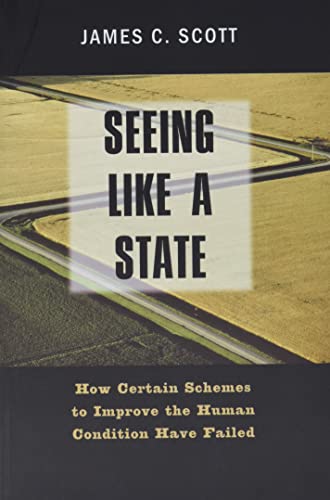
Seeing like a State: How Certain Schemes to Improve the Human Condition Have Failed
📄 Viewing lite version
Full site ›
25.95
USD
🛒 Buy New on Amazon 🇺🇸
Book Details
Author(s)James C. Scott,
PublisherYale University Press
ISBN / ASIN0300078153
ISBN-139780300078152
Sales Rank17,944
CategoryPolitical Science
MarketplaceUnited States 🇺🇸
Description ▲
Similar Products ▼
- Against the Grain: A Deep History of the Earliest States
- The Art of Not Being Governed: An Anarchist History of Upland Southeast Asia (Yale Agrarian Studies Series)
- Weapons of the Weak: Everyday Forms of Peasant Resistance
- Two Cheers for Anarchism: Six Easy Pieces on Autonomy, Dignity, and Meaningful Work and Play
- Imagined Communities: Reflections on the Origin and Spread of Nationalism
- Domination and the Arts of Resistance: Hidden Transcripts
- The Great Transformation: The Political and Economic Origins of Our Time
- Changes in the Land: Indians, Colonists, and the Ecology of New England
- The Anti-Politics Machine: Development, Depoliticization, and Bureaucratic Power in Lesotho
- Palestinian Walks: Forays into a Vanishing Landscape
More Books in Political Science
The Millennium Development Goals and Beyond: Internati…
View
Transnational Networks in Regional Integration: Govern…
View
Forensic Psychophysiology Using the Polygraph: Scienti…
View
Gender, Islam and Democracy in Indonesia (ASAA Women i…
View
E-Governance: A Change Management Tool
View
Shop Floor Bargaining and the State: Historical and Co…
View
Red State Uprising: How to Take Back America
View
A Community Health Approach to the Assessment of Infan…
View
Foreign Aid and Landmine Clearance: Governance, Politi…
View