An account of all the new and surprising evidence now available that contradicts the standard narrative for the beginnings of the earliest civilizations
Why did humans abandon hunting and gathering for sedentary communities dependent on livestock and cereal grains, and governed by precursors of today’s states? Most people believe that plant and animal domestication allowed humans, finally, to settle down and form agricultural villages, towns, and states, which made possible civilization, law, public order, and a presumably secure way of living. But archaeological and historical evidence challenges this narrative. The first agrarian states, says James C. Scott, were born of accumulations of domestications: first fire, then plants, livestock, subjects of the state, captives, and finally women in the patriarchal family—all of which can be viewed as a way of gaining control over reproduction.
Scott explores why we avoided sedentism and plow agriculture, the advantages of mobile subsistence, the unforeseeable disease epidemics arising from crowding plants, animals, and grain, and why all early states are based on millets and cereal grains and unfree labor. He also discusses the “barbarians” who long evaded state control, as a way of understanding continuing tension between states and nonsubject peoples.
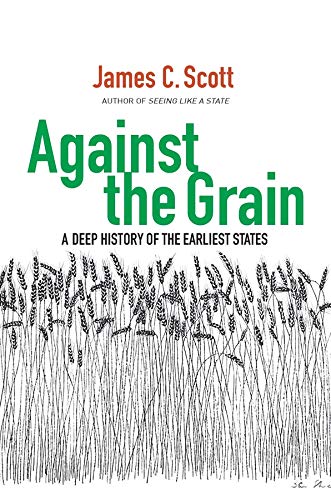
Against the Grain: A Deep History of the Earliest States
📄 Viewing lite version
Full site ›
Book Details
Author(s)Scott, James C.
PublisherYale University Press
ISBN / ASIN0300182910
ISBN-139780300182910
AvailabilityIn Stock.
Sales Rank71,584
MarketplaceUnited States 🇺🇸
Description ▲
Similar Products ▼
- Seeing like a State: How Certain Schemes to Improve the Human Condition Have Failed
- The Art of Not Being Governed: An Anarchist History of Upland Southeast Asia (Yale Agrarian Studies Series)
- Affluence Without Abundance: What We Can Learn from the World's Most Successful Civilisation
- Two Cheers for Anarchism: Six Easy Pieces on Autonomy, Dignity, and Meaningful Work and Play
- The Fate of Rome: Climate, Disease, and the End of an Empire (The Princeton History of the Ancient World)
- The Great Leveler: Violence and the History of Inequality from the Stone Age to the Twenty-First Century (The Princeton Economic History of the Western World)
- Who We Are and How We Got Here: Ancient DNA and the New Science of the Human Past
- Tamed
- Weapons of the Weak: Everyday Forms of Peasant Resistance
- A Cold Welcome: The Little Ice Age and Europe’s Encounter with North America