This title is printed in full color throughout.
From one of the most original and influential neuroscientists at work today, here is an exploration of consciousness unlike any other as told by Galileo, who opened the way for the objectivity of science and is now intent on making subjective experience a part of science as well.
Galileo s journey has three parts, each with a different guide. In the first, accompanied by a scientist who resembles Francis Crick, he learns why certain parts of the brain are important and not others, and why consciousness fades with sleep. In the second part, when his companion seems to be named Alturi (Galileo is hard of hearing; his companion s name is actually Alan Turing), he sees how the facts assembled in the first part can be unified and understood through a scientific theory a theory that links consciousness to the notion of integrated information (also known as phi). In the third part, accompanied by a bearded man who can only be Charles Darwin, he meditates on how consciousness is an evolving, developing, ever-deepening awareness of ourselves in history and culture that it is everything we have and everything we are.
Not since G del, Escher, Bach has there been a book that interweaves science, art, and the imagination with such originality. This beautiful and arresting narrative will transform the way we think of ourselves and the world.
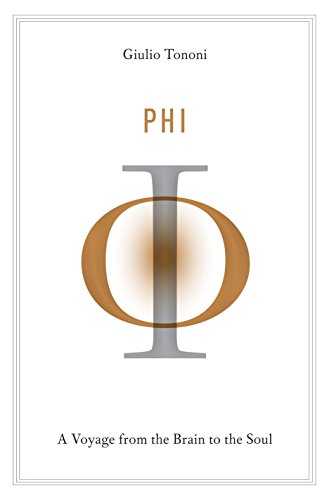
Phi: A Voyage from the Brain to the Soul
📄 Viewing lite version
Full site ›
Book Details
Author(s)Tononi, Giulio
PublisherPantheon
ISBN / ASIN030790721X
ISBN-139780307907219
AvailabilityIn Stock.
Sales Rank198,422
CategoryPhilosophy
MarketplaceUnited States 🇺🇸
Description ▲
More Books in Philosophy
Led Zeppelin and Philosophy: All Will Be Revealed (Pop…
View
Nothingness and Emptiness: A Buddhist Engagement with …
View
Cultivating Communities of Practice
View
Models of God and Alternative Ultimate Realities
View
Libertarianism Defended
View
Irony in the Age of Empire: Comic Perspectives on Demo…
View
From Kant to Davidson: Philosophy and the Idea of the …
View
An Introduction to Biblical Ethics: Walking in the Way…
View