Why is the Mona Lisa the most famous painting in the world? Why did Facebook succeed when other social networking sites failed? Did the surge in Iraq really lead to less violence? How much can CEO’s impact the performance of their companies? And does higher pay incentivize people to work hard?
If you think the answers to these questions are a matter of common sense, think again. As sociologist and network science pioneer Duncan Watts explains in this provocative book, the explanations that we give for the outcomes that we observe in life—explanation that seem obvious once we know the answer—are less useful than they seem.
Drawing on the latest scientific research, along with a wealth of historical and contemporary examples, Watts shows how common sense reasoning and history conspire to mislead us into believing that we understand more about the world of human behavior than we do; and in turn, why attempts to predict, manage, or manipulate social and economic systems so often go awry.
It seems obvious, for example, that people respond to incentives; yet policy makers and managers alike frequently fail to anticipate how people will respond to the incentives they create. Social trends often seem to have been driven by certain influential people; yet marketers have been unable to identify these “influencers” in advance. And although successful products or companies always seem in retrospect to have succeeded because of their unique qualities, predicting the qualities of the next hit product or hot company is notoriously difficult even for experienced professionals.
Only by understanding how and when common sense fails, Watts argues, can we improve how we plan for the future, as well as understand the present—an argument that has important implications in politics, business, and marketing, as well as in science and everyday life.
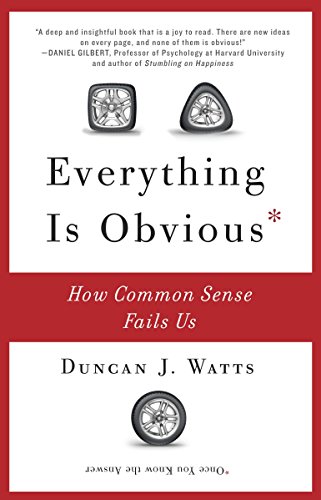
Everything Is Obvious: How Common Sense Fails Us
📄 Viewing lite version
Full site ›
Book Details
Author(s)Watts, Duncan J.
PublisherCurrency
ISBN / ASIN0307951790
ISBN-139780307951793
AvailabilityIn Stock
CategoryBusiness & Economics
MarketplaceUnited States 🇺🇸
Description ▲
More Books in Business & Economics
Business Cycles and Forecasting
View
Development Economics: Its Position in the Present Sta…
View
Cost Systems Design
View
So You Want to Dance on Broadway
View
The Blueprint: Reviving Innovation, Rediscovering Risk…
View
Managing IT Outsourcing, Second Edition
View
Education and the Creation of Capital in the Early Ame…
View
Global Corruption Report 2005: Special Focus: Corrupti…
View
More Tales for Trainers: Using Stories and Metaphors t…
View