Malaria is an infectious disease common to several parts of the world, including Africa, northern South America, and Asia. During their service in the military, U.S. active members may be sent to any part of the world, including parts of the world where Malaria is an issue. In Liberia in 2003, for example, there was a 28 percent attack rate in Marines who spent a short time ashore, and half of the 80 Marines affected needed to be evacuated to Germany. This was not only costly to the U.S. military but dangerous as well. To fight against this disease, there exists a Malaria Vaccine program in the U.S. military. However, there exists a variety of potential vaccine targets for the most severe and important form of malaria; malaria from the species Plasmodium falciparum. Issues also arise with the fact that there are three possible stages to create vaccines against—preerythrocytic, blood, or transmission.
The Department of Defense (DoD), through the commanding general of the U.S. Army Medical Research and Materiel Command (USAMRMC), requested that the Institute of Medicine (IOM) conduct a programmatic review of the military Plasmodium falciparum malaria vaccine research and development program. There was to be a focus on vaccine against the preerythrocytic and blood stages. The IOM formed a committee of 11 experts with collective expertise in malaria vaccine research, parasite immunology, malarial biology, clinical trials and regulatory affairs, industrial and public-sector vaccine development, biologic products research and development (vaccinology), military research and development programs, tropical medicine, and public health.
The committee focused different tasks including determining whether the DoD malaria vaccine research and development program is scientifically sound and able to achieve the vaccine program objectives within specified timelines, recommending how to overcome significant, identified barriers, and identifying major strategic goals and timelines based on the material received and presentations made by the DoD's program representatives. Battling Malaria: Strengthening the U.S. Military Malaria Vaccine Program presents the committee's findings, current malaria vaccines, and recommendations for the development of the U.S. Military vaccine research.
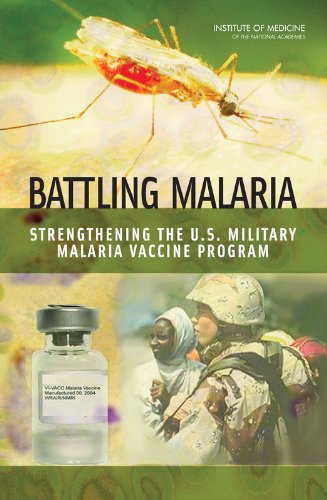
Battling Malaria: Strengthening the U.S. Military Malaria Vaccine Program
📄 Viewing lite version
Full site ›
Book Details
PublisherNational Academies Press
ISBN / ASIN0309101689
ISBN-139780309101684
AvailabilityUsually ships in 1 to 3 weeks
Sales Rank4,022,283
CategoryTechnology & Engineering
MarketplaceUnited States 🇺🇸
Description ▲
More Books in Technology & Engineering
Fourth Dimension in Building: Strategies for Avoiding …
View
Design and Evaluation of Rigid and Flexible Pavements,…
View
Nuclear Nonproliferation: Status Of U.s. Efforts To Im…
View
Time-Domain Numerical Methods for Modelling Antennas, …
View
The Rise of the Standard Model: A History of Particle …
View
Synthesis, Properties and Crystal Chemistry of Perovsk…
View
Error Propagation in Environmental Modelling with GIS …
View
Crops And Environmental Change: An Introduction To Eff…
View
Multicarrier Modulation with Low PAR: Applications to …
View