Since the first commercial introduction of transgenic corn plants in 1995, biotechnology has provided enormous benefits to agricultural crop production. Research is underway to develop a much broader range of genetically engineered organisms (GEOs), including fish, trees, microbes, and insects, that could have the potential to transform fields such as aquaculture, biofuels production, bioremediation, biocontrol, and even the production of pharmaceuticals . However, biotechnology is not without risk and continues to be an extremely controversial topic. Chief among the concerns is the potential ecological effects of GEOs that interact with wildlife and habitats.
The U.S. Geological Survey (USGS) is charged with providing scientific advice to inform federal agencies that manage wildlife and their habitats. USGS has identified biotechnology as one of its major challenges for future research. Seeing an opportunity to initiate a dialogue between ecologists and developers of GEOs about this challenge, the USGS and the National Research Council (NRC) held a two-day workshop in November of 2007, to identify research activities with the greatest potential to provide the information needed to assess the ecological effects of GEOs on wildlife and habitats. The workshop, designed to approach the research questions from a habitat, rather than transgenic organism, perspective, is summarized in this book.
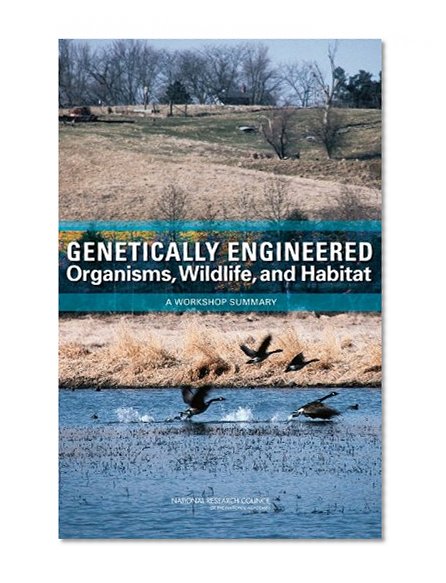
Genetically Engineered Organisms, Wildlife, and Habitat:: A Workshop Summary
📄 Viewing lite version
Full site ›
Book Details
PublisherNational Academies Press
ISBN / ASIN0309120853
ISBN-139780309120852
AvailabilityUsually ships in 24 hours
Sales Rank8,450,753
CategoryTechnology & Engineering
MarketplaceUnited States 🇺🇸
Description ▲
More Books in Technology & Engineering
Fourth Dimension in Building: Strategies for Avoiding …
View
Design and Evaluation of Rigid and Flexible Pavements,…
View
Nuclear Nonproliferation: Status Of U.s. Efforts To Im…
View
Time-Domain Numerical Methods for Modelling Antennas, …
View
The Rise of the Standard Model: A History of Particle …
View
Synthesis, Properties and Crystal Chemistry of Perovsk…
View
Error Propagation in Environmental Modelling with GIS …
View
Crops And Environmental Change: An Introduction To Eff…
View
Multicarrier Modulation with Low PAR: Applications to …
View