Not that Poet Laureate Pinsky gets vague or touchy-feely on us. Poetry, like God, is in the details, and the author starts with the building blocks, the amino acids, of verse: accent and duration. Even the most jaded of readers will benefit from his syllable-by-syllable examination of Thomas Campion's "Now Winter Nights Enlarge" and Wallace Stevens's "Sunday Morning." Moving on through discussions of syntax and line, meter and rhyme (or lack thereof), Pinsky enlists both the usual suspects (Shakespeare, Frost, Hardy, Eliot, Bishop) and some less customary ones (Gilbert & Sullivan, Louise Gluck, and the splendid James McMichael) to make his points. These poems are, in some sense, teaching tools for the author. Yet even his on-the-fly commentary causes us to see them in a new light. Here he is, for example, on the near-monotonous minimalism of W.C. Williams's "To a Poor Old Woman": "The poem dramatizes the taking in of a supposedly ordinary experience, and the playful, almost hectoring repetitions are like an effective sermon in praise of simplicity." The Sounds of Poetry is no less effective a sermon. It leaves your ear (and your heart) attuned to the pleasurable play of poetic language and persuades you that hearing is, indeed, believing. --James Marcus
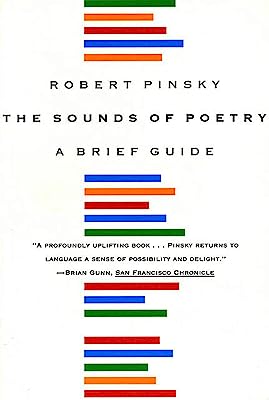
The Sounds of Poetry: A Brief Guide
📄 Viewing lite version
Full site ›
Book Details
Author(s)Robert Pinsky
PublisherFarrar, Straus and Giroux
ISBN / ASIN0374526176
ISBN-139780374526177
AvailabilityUsually ships in 24 hours
Sales Rank374,067
CategoryLanguage Arts & Disciplines
MarketplaceUnited States 🇺🇸
Description ▲
While it's hardly the most traveled of literary destinations, poetry has suffered from no shortage of guidebooks. Still, these poetic baedekers tend to get bogged down in terminology and historical hairsplitting, while the actual music gets lost in the shuffle. We should be thankful, then, for Robert Pinsky's brief, wonderfully readable volume, in which he zooms in on verse as acoustic artifact: "When I say to myself a poem by Emily Dickinson or George Herbert, the artist's medium is my breath. The reader's breath and hearing embody the poet's words. This makes the art physical, intimate, vocal, and individual."
More Books in Language Arts & Disciplines
Meaning and Grammar - 2nd Edition: An Introduction to …
View
Challenges for Arabic Machine Translation (Natural Lan…
View
Cyberpragmatics (Pragmatics & Beyond New Series)
View
Pierre Bourdieu: A Critical Introduction to Media and …
View
Tools for Matching Readers to Texts: Research-Based Pr…
View
The Development of Language (5th Edition)
View
Medical Writing in Early Modern English (Studies in En…
View
Language Death: Factual and Theoretical Explorations w…
View