Isaacs, who is Director of the Dialogue Project at MIT and a consultant to major corporations, including AT&T and Intel, believes that corporate, political, and personal communication can be a process of thinking together--as opposed to thinking alone, and then trying to convince others of our positions by refusing to consider other opinions, withholding information, and ultimately getting angry and defensive. This is not pie-in-the-sky, let's-all-hold-hands-and-sing stuff. He offers concrete ideas for both listening and speaking; for avoiding the forces that undermine meaningful conversation; for changing the physical setting of the dialogue to change its quality. The outcome, he says, can be quite different from the traditional winner-loser structure of arguments and debates. Businesses can make more reasoned decisions, and thus earn more money. Governments can create peaceful resolutions to seemingly intractable problems. (For example, Isaacs cites secret conversations between Nelson Mandela and F.W. de Klerk in South Africa, which occurred over a number of years, while Mandela was still under arrest and led to a new framework for their country.) And, although this is a book primarily geared toward managers, even married couples can learn a few new ways to communicate. --Lou Schuler
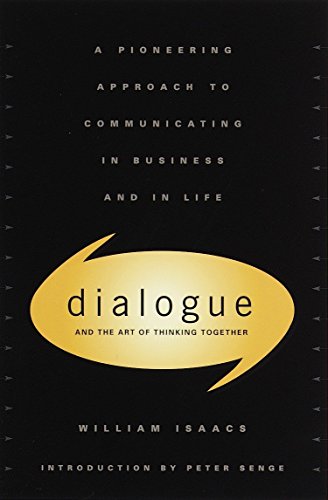
Dialogue: The Art Of Thinking Together
📄 Viewing lite version
Full site ›
Book Details
Author(s)William Isaacs
PublisherCrown Business
ISBN / ASIN0385479999
ISBN-139780385479998
AvailabilityUsually ships in 1-2 business days
Sales Rank210,918
CategoryBusiness & Economics
MarketplaceUnited States 🇺🇸
Description ▲
Modern conversation is a lot like nuclear physics, argues William Isaacs. Lots of atoms zoom around, many of which just rush past each other. But others collide, creating friction. Even if our atomic conversations don't turn contentious, they often just serve to establish each participant's place in the cosmos. One guy shares a statistic he's privy to, another shares another fact, and on and on. Each person fires off a tidbit, pauses to reload while someone else talks, then fires off another. In Dialogue and the Art of Thinking Together, Isaacs explains how we can do better than that.
Similar Products ▼
- On Dialogue (Routledge Classics) (Volume 76)
- Leading with Questions: How Leaders Find the Right Solutions by Knowing What to Ask
- The Fifth Discipline: The Art & Practice of The Learning Organization
- Leading Organizations: Perspectives for a New Era
- Everything Is Workable: A Zen Approach to Conflict Resolution
- The Reflective Practitioner: How Professionals Think In Action
- Humble Inquiry: The Gentle Art of Asking Instead of Telling
- On Dialogue (Routledge Great Minds) (Volume 4)
- Reading the Room: Group Dynamics for Coaches and Leaders
- Immunity to Change: How to Overcome It and Unlock the Potential in Yourself and Your Organization (Leadership for the Common Good)
More Books in Business & Economics
Business Cycles and Forecasting
View
Development Economics: Its Position in the Present Sta…
View
Cost Systems Design
View
So You Want to Dance on Broadway
View
The Blueprint: Reviving Innovation, Rediscovering Risk…
View
Managing IT Outsourcing, Second Edition
View
Education and the Creation of Capital in the Early Ame…
View
Global Corruption Report 2005: Special Focus: Corrupti…
View
More Tales for Trainers: Using Stories and Metaphors t…
View