Search Books
Design of Experiments: An I…

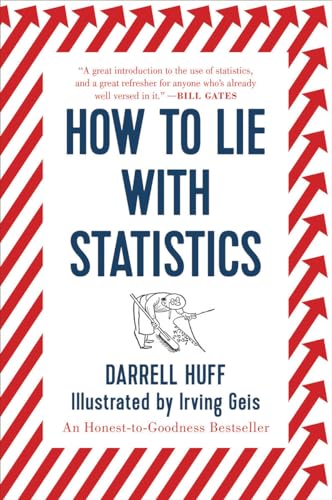
How to Lie with Statistics

Author Darrell Huff, Irving Geis,
Publisher W. W. Norton & Company
Category Mathematics
📄 Viewing lite version Full site ›
🌎 Shop on Amazon — choose country
8.89 USD
🛒 Buy New on Amazon 🇺🇸
Share:
Book Details
ISBN / ASIN0393310728
ISBN-139780393310726
Sales Rank6,708
CategoryMathematics
MarketplaceUnited States 🇺🇸

Description

"There is terror in numbers," writes Darrell Huff in How to Lie with Statistics. And nowhere does this terror translate to blind acceptance of authority more than in the slippery world of averages, correlations, graphs, and trends. Huff sought to break through "the daze that follows the collision of statistics with the human mind" with this slim volume, first published in 1954. The book remains relevant as a wake-up call for people unaccustomed to examining the endless flow of numbers pouring from Wall Street, Madison Avenue, and everywhere else someone has an axe to grind, a point to prove, or a product to sell. "The secret language of statistics, so appealing in a fact-minded culture, is employed to sensationalize, inflate, confuse, and oversimplify," warns Huff.

Although many of the examples used in the book are charmingly dated, the cautions are timeless. Statistics are rife with opportunities for misuse, from "gee-whiz graphs" that add nonexistent drama to trends, to "results" detached from their method and meaning, to statistics' ultimate bugaboo--faulty cause-and-effect reasoning. Huff's tone is tolerant and amused, but no-nonsense. Like a lecturing father, he expects you to learn something useful from the book, and start applying it every day. Never be a sucker again, he cries!

Even if you can't find a source of demonstrable bias, allow yourself some degree of skepticism about the results as long as there is a possibility of bias somewhere. There always is.

Read How to Lie with Statistics. Whether you encounter statistics at work, at school, or in advertising, you'll remember its simple lessons. Don't be terrorized by numbers, Huff implores. "The fact is that, despite its mathematical base, statistics is as much an art as it is a science." --Therese Littleton

Similar Products

Topics in Finite and Discrete Mathematics
View
Applications of Mathematics in Engineering and Economi…
View
Linear Algebra Supplement to Accompany Calculus with A…
View
Random Matrix Models and their Applications (Mathemati…
View
Continuous Crossed Products and Type III Von Neumann A…
View
First European Congress of Mathematics Paris, July 6-1…
View
Workshop Statistics: Discovery with Data, JMP Companio…
View
XXVI International Workshop on Geometrical Methods in …
View
Social Policy Reform in Hong Kong and Shanghai: A Tale…
View