“The Knowledge Illusion is filled with insights on how we should deal with our individual ignorance and collective wisdom.” —Steven Pinker
We all think we know more than we actually do.
Humans have built hugely complex societies and technologies, but most of us don’t even know how a pen or a toilet works. How have we achieved so much despite understanding so little? Cognitive scientists Steven Sloman and Philip Fernbach argue that we survive and thrive despite our mental shortcomings because we live in a rich community of knowledge. The key to our intelligence lies in the people and things around us. We’re constantly drawing on information and expertise stored outside our heads: in our bodies, our environment, our possessions, and the community with which we interact—and usually we don’t even realize we’re doing it.
The human mind is both brilliant and pathetic. We have mastered fire, created democratic institutions, stood on the moon, and sequenced our genome. And yet each of us is error prone, sometimes irrational, and often ignorant. The fundamentally communal nature of intelligence and knowledge explains why we often assume we know more than we really do, why political opinions and false beliefs are so hard to change, and why individual-oriented approaches to education and management frequently fail. But our collaborative minds also enable us to do amazing things. The Knowledge Illusion contends that true genius can be found in the ways we create intelligence using the community around us.
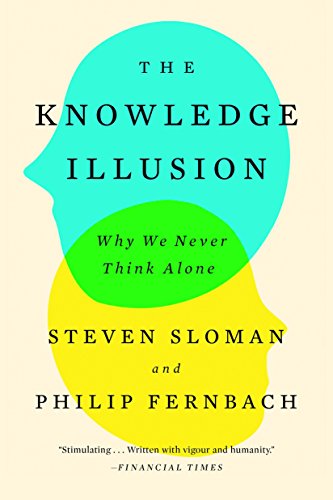
The Knowledge Illusion: Why We Never Think Alone
📄 Viewing lite version
Full site ›
Book Details
Author(s)Sloman, Steven
PublisherRiverhead Books
ISBN / ASIN0399184368
ISBN-139780399184369
AvailabilityIn Stock.
Sales Rank122,976
MarketplaceUnited States 🇺🇸
Description ▲
Similar Products ▼
- The Enigma of Reason
- Denying to the Grave: Why We Ignore the Facts That Will Save Us
- Why We Do What We Do: Understanding Self-Motivation
- The Enigma of Reason
- Diffusion of Innovations, 5th Edition
- The Death of Expertise: The Campaign against Established Knowledge and Why it Matters
- Appreciative Inquiry: A Positive Revolution in Change
- The Death of Expertise: The Campaign against Established Knowledge and Why it Matters
- How Emotions Are Made
- Causal Models: How People Think About the World and Its Alternatives