Search Books
Social and Cultural Anthrop… Japanese Telecommunications…

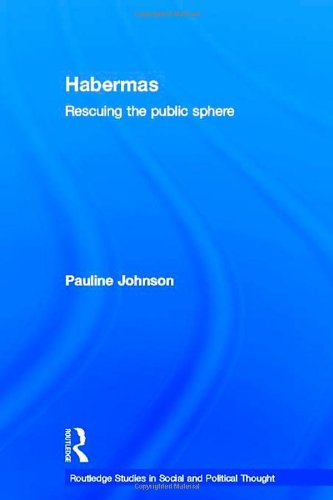
Habermas: Rescuing the Public Sphere (Routledge Studies in Social and Political Thought)

Author Pauline Johnson
Publisher Routledge
Category Social Science
📄 Viewing lite version Full site ›
🌎 Shop on Amazon — choose country
156.75 165.00 USD
🛒 Buy New on Amazon 🇺🇸 🏷 Buy Used — $131.92

✓ Usually ships in 2 to 4 weeks

Share:
Book Details
PublisherRoutledge
ISBN / ASIN0415367697
ISBN-139780415367691
AvailabilityUsually ships in 2 to 4 weeks
Sales Rank11,499,368
MarketplaceUnited States 🇺🇸

Description

If we are to believe what many sociologists are telling us, the public sphere is in a near terminal state. Our ability to build solidarities with strangers and to agree on the general significance of needs and problems seems to be collapsing. These cultural potentials appear endangered by a newly aggressive attempt to universalize and extend the norms of the market. For four decades Habermas has been trying to bring the claims of a modern public sphere before us. His vast oeuvre has investigated its historical, sociological and theoretical preconditions, has explored its relevance and meaning as well as diagnosing its on-going crises. In the contemporary climate, a systematic look at Habermas’ lifelong project of rescuing the modern public sphere seems an urgent task.

This study reconstructs major developments in Habermas’ thinking about the public sphere, and is a contribution to the current vigorous debate over its plight. It marshals the significance of Habermas’ lifetime of work on this topic to illuminate what is at stake in a contemporary interest in rescuing an embattled modern public sphere.

Habermas’ project of rescuing the neglected potentials of Enlightenment legacies has been deeply controversial. For many, it is too lacking in radical commitments to warrant its claim to a contemporary place within a critical theory tradition. Against this developing consensus, Pauline Johnson describes Habermas’ project as one that is still informed by utopian energies, even though his own construction of emancipatory hopes itself proves to be too narrow and one-sided.

Last Flesh: Life in the Transhuman Era
View
Sociology in Pictures: Research Methods
View
TimeLinks: Approaching Level, Grade 1, The Declaratio…
View
TimeLinks: Grade 5, Beyond Level, Leveled Places & Eve…
View
Timelinks, Grade 6, People, Places, and Cultures in Eu…
View
Cities in World Perspective
View
Business, Government, and Society: Managing Competitiv…
View
Introduction to Criminal Justice (6th Edition)
View
The Third World War
View