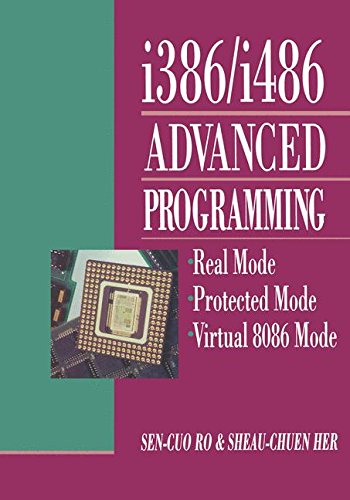
i386/i486 Advanced Programming: Real Mode Protected Mode Virtual 8086 Mode
📄 Viewing lite version
Full site ›
⌛ 🇬🇧 United Kingdom pricing being fetched…
Prices will appear once fetched — usually within a few minutes.
View in:
🇺🇸 USA
Book Details
Author(s)Sen-cuo Ro
PublisherSpringer
ISBN / ASIN0442013779
ISBN-139780442013776
CategoryComputers
MarketplaceUnited Kingdom 🇬🇧
Description ▲
This book gives x86 assembly language programmers a view about how to use the resources and features provided by the i386/i486 processor, the newest and most advanced microprocessor from the Intel x86 family. Because the i386/i486 processor is entirely compatible with its predecessor, the 8086/88 processor, this book concentrates on the enhanced features compared to its predecessor. We assume the reader is already familiar with the concepts of 8086/88 assembly language programming. Our goal is to show you the programming methods that apply to powerful features of the i386/i486. The i387 math coprocessor is not discussed in this book. A detailed explanation about how to use each i386/i486 instruction is not covered in this book. However, we list the complete i386/i486 instruction set in Appendix B. Organization of the Book This book is divided into sections to help readers start learning from the concepts that are similar to the 8086/8088 processor. Then, the discussion shifts to the resources and environment of the i386/i486 processor. Throughout the book, real-life program examples are used to illustrate in detail how you can use the enhanced features or functions of the processor. Chapter 1 introduces the i386/i486 architecture and its enhanced features. The discussion includes the operation mode, general registers, segment registers, system registers, and system data structures. Chapter 2 discusses the method that the i386/i486 processor uses to make itself fully compatible with the 8086/88 processor and to define the interrupt vector table address, which is different from the 8086/88 processor.This book gives x86 assembly language programmers a view about how to use the resources and features provided by the i386/i486 processor, the newest and most advanced microprocessor from the Intel x86 family. Because the i386/i486 processor is entirely compatible with its predecessor, the 8086/88 processor, this book concentrates on the enhanced features compared to its predecessor. We assume the reader is already familiar with the concepts of 8086/88 assembly language programming. Our goal is to show you the programming methods that apply to powerful features of the i386/i486. The i387 math coprocessor is not discussed in this book. A detailed explanation about how to use each i386/i486 instruction is not covered in this book. However, we list the complete i386/i486 instruction set in Appendix B. Organization of the Book This book is divided into sections to help readers start learning from the concepts that are similar to the 8086/8088 processor. Then, the discussion shifts to the resources and environment of the i386/i486 processor. Throughout the book, real-life program examples are used to illustrate in detail how you can use the enhanced features or functions of the processor. Chapter 1 introduces the i386/i486 architecture and its enhanced features. The discussion includes the operation mode, general registers, segment registers, system registers, and system data structures. Chapter 2 discusses the method that the i386/i486 processor uses to make itself fully compatible with the 8086/88 processor and to define the interrupt vector table address, which is different from the 8086/88 processor.
More Books in Computers
Windows XP, Vol. 1 (SELECT Series)
View
Internet Searching and Indexing: The Subject Approach
View
Control Problems in Industry: Proceedings from the SIA…
View
Open Source Systems Security Certification
View
Java: Data Structures and Programming
View
User-Centered Web Development
View
Query Processing in Database Systems (Topics in Inform…
View
Fundamentals of SQL Server 2005
View
Dreamweaver CS4: The Missing Manual (Spanish Edition)
View