Search Books

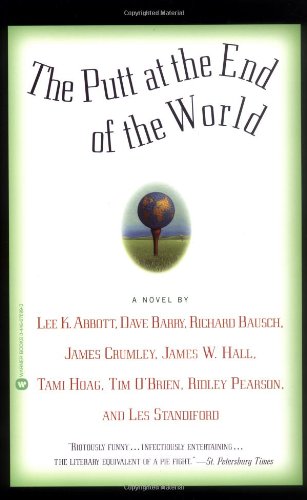
The Putt at the End of the World

Author Lee K. Abbott, Dave Barry, Richard Bausch, James Crumley, James W. Hall, Tami Hoag, Tim O'Brien, Ridley Pearson, Les Standiford
Publisher Grand Central Publishing
📄 Viewing lite version Full site ›
🌎 Shop on Amazon — choose country
18.99 USD
🛒 Buy New on Amazon 🇺🇸 🏷 Buy Used — $0.01

✓ Usually ships in 2 to 3 weeks

Share:
Book Details
ISBN / ASIN0446676993
ISBN-139780446676991
AvailabilityUsually ships in 2 to 3 weeks
Sales Rank2,903,659
MarketplaceUnited States 🇺🇸

Description

There's a great tradition of golf fiction, stretching from P.G. Wodehouse's Edwardian follies to John Updike's narrative birdies and chip shots. The Putt at the End of the World is a worthy addition to the canon, in spite of the fact (or because of the fact) that it's a team effort. Nine authors, including such worthies as Dave Barry, Tami Hoag, Tim O'Brien, Lee K. Abbott, and Les Standiford, have contributed chapters to this farcical thriller. The premise, which is less wacky than it initially seems, involves a software tycoon named Phillip Bates, who's built a deluxe golf course north of Edinburgh. To kick things off he convenes a celebrity invitational, and draws not only a clutch of world-class hackers but several terrorists, counterterrorists, and what appear to be counter-counterterrorists. Clearly there's more at stake here than a mere 18 holes.

Slapped together by one author after another, the crazy plot is surprisingly consistent. Yet the contributors have made no effort to disguise their individual styles, which range from Barry's potty-mouthed slapstick to Richard Bausch's tonier stuff to James Crumley's pulp fiction. Indeed, this shift in tone is one of the book's great pleasures. So is the sex and satire, if not necessarily in that order. Still, the ultimate reason to read The Putt at the End of the World is for its strange-but-true evocation of the game itself. Here's Tim O'Brien's take on a ball with a mind of its own:

For the first thirty feet, the old Titlist did not touch the earth, heading for orbit, engines roaring, but then suddenly the rain and wind and fog forced a scrubbed mission. Gravity reasserted itself. By pure chance--a miracle, some would call it--the ball dropped heavily onto the green, not five feet from the cup.... It caught a sidehill slope. It wobbled off line for a second, then straightened out and continued its erratic pilgrimage toward destiny.
Fictionally speaking, at least, that's what we call a hole in one. --William Davies