Search Books
Supply Chain Management (5t… Power Your Career: The Art …

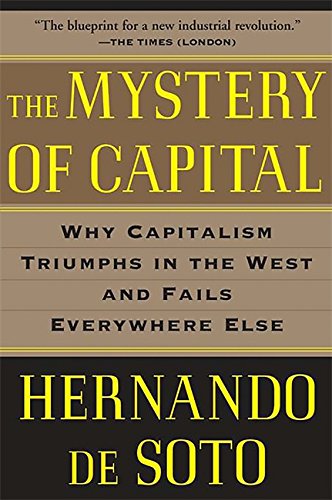
The Mystery of Capital: Why Capitalism Triumphs in the West and Fails Everywhere Else

Author Hernando De Soto
Publisher Basic Books
Category Business & Economics
📄 Viewing lite version Full site ›
🌎 Shop on Amazon — choose country
17.99 USD
🛒 Buy New on Amazon 🇺🇸

✓ In Stock.

Share:
Book Details
PublisherBasic Books
ISBN / ASIN0465016154
ISBN-139780465016150
AvailabilityIn Stock.
Sales Rank102,829
MarketplaceUnited States 🇺🇸

Description

It's become clear by now the fall of the Berlin Wall and the collapse of communism in most places around the globe hasn't ushered in an unequivocal flowering of capitalism in the developing and postcommunist world. Western thinkers have blamed this on everything from these countries' lack of sellable assets to their inherently non-entrepreneurial "mindset." In this book, the renowned Peruvian economist and adviser to presidents and prime ministers Hernando de Soto proposes and argues another reason: it's not that poor, postcommunist countries don't have the assets to make capitalism flourish. As de Soto points out by way of example, in Egypt, the wealth the poor have accumulated is worth 55 times as much as the sum of all direct foreign investment ever recorded there, including that spent on building the Suez Canal and the Aswan Dam.

No, the real problem is that such countries have yet to establish and normalize the invisible network of laws that turns assets from "dead" into "liquid" capital. In the West, standardized laws allow us to mortgage a house to raise money for a new venture, permit the worth of a company to be broken up into so many publicly tradable stocks, and make it possible to govern and appraise property with agreed-upon rules that hold across neighborhoods, towns, or regions. This invisible infrastructure of "asset management"--so taken for granted in the West, even though it has only fully existed in the United States for the past 100 years--is the missing ingredient to success with capitalism, insists de Soto. But even though that link is primarily a legal one, he argues that the process of making it a normalized component of a society is more a political--or attitude-changing--challenge than anything else.

With a fleet of researchers, de Soto has sought out detailed evidence from struggling economies around the world to back up his claims. The result is a fascinating and solidly supported look at the one component that's holding much of the world back from developing healthy free markets. --Timothy Murphy

Business Cycles and Forecasting
View
Development Economics: Its Position in the Present Sta…
View
Cost Systems Design
View
So You Want to Dance on Broadway
View
The Blueprint: Reviving Innovation, Rediscovering Risk…
View
Managing IT Outsourcing, Second Edition
View
Education and the Creation of Capital in the Early Ame…
View
Global Corruption Report 2005: Special Focus: Corrupti…
View
More Tales for Trainers: Using Stories and Metaphors t…
View