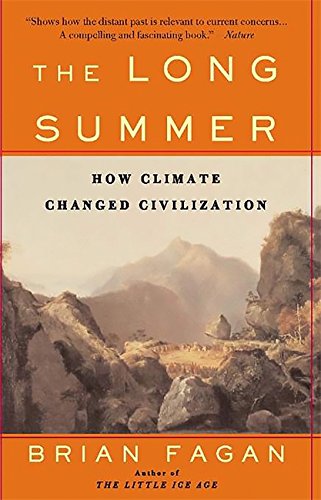
The Long Summer: How Climate Changed Civilization
📄 Viewing lite version
Full site ›
Book Details
Author(s)Fagan, Brian
PublisherBasic Books
ISBN / ASIN0465022820
ISBN-139780465022823
AvailabilityIn Stock.
Sales Rank728,779
CategoryHistory
MarketplaceUnited States 🇺🇸
Description ▲
A professor of anthropology by training, Fagan traces the effects of climactic change on civilizations over the past 15,000 years--a period of prolonged global warning that has only accelerated over the past 150 years. In particular, he's interested in how civilizations have responded to, or been radically altered by, changes in environment. One of Fagan's most compelling examples is his detailed history of the city of Ur, in what is now modern-day Iraq. Once a great city in one of the world's earliest civilizations, it first thrived thanks to abundant rainfall and then suffered even more severely when the Indian Ocean monsoons shifted southward, changing rain patterns. By 2000 B.C. its agricultural economy had collapsed, and today it is an abandoned landscape, an assemblage of decaying shrines in the harshest of deserts. Fagan views this event as pivotal. It was, he writes, "the first time an entire city disintegrated in the face of environmental catastrophe." But not, Fagan notes, the last. In his epilogue, which covers the last 800 years of human history, Fagan explores the climatic upheavals that left 20 million dead in famine-related epidemics in the 19th century. He notes that today 200 million people barely survive on marginal agricultural land in places such as northeastern Brazil, Ethiopia, and the Saharan Sahel. If temperatures rise much above current levels, and rising seas flood coastal plains, the devastation could dwarf any disaster humankind has previously known. Fagan doesn't offer easy solutions, but he presents a compelling history of climate's role in the background--and sometimes foreground--of human history. --Keith Moerer
More Books in History
The Bet, and Other Stories
View
Pakistan and the Bomb: Public Opinion and Nuclear Opti…
View
Writing National Histories: Western Europe Since 1800
View
Empire in Eclipse
View
Monks and Laymen in Byzantium, 843-1118
View
The Wilmington and Western Railroad (Images of Rail: D…
View
Black Sailor, White Navy: Racial Unrest in the Fleet d…
View
Feasibility of Laser Power Transmission to a High-Alti…
View
The Democratic Republic: 1801-1815
View