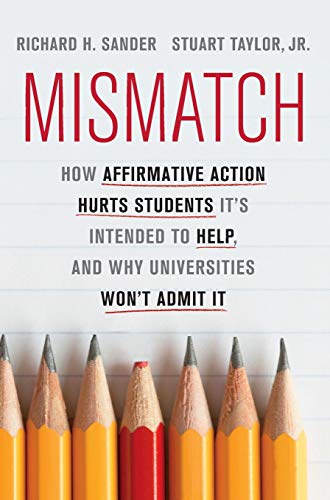
Mismatch: How Affirmative Action Hurts Students It's Intended to Help, and Why Universities Won't Admit It
📄 Viewing lite version
Full site ›
⌛ 🇫🇷 France pricing being fetched…
Prices will appear once fetched — usually within a few minutes.
View in:
🇺🇸 USA
Book Details
Author(s)Sander, Richard
PublisherBasic Books
ISBN / ASIN0465029965
ISBN-139780465029969
CategoryEducation
MarketplaceFrance 🇫🇷
Description ▲
The debate over affirmative action has raged for over four decades, with little give on either side. Most agree that it began as noble effort to jump-start racial integration; many believe it devolved into a patently unfair system of quotas and concealment. Now, with the Supreme Court set to rule on a case that could sharply curtail the use of racial preferences in American universities, law professor Richard Sander and legal journalist Stuart Taylor offer a definitive account of what affirmative action has become, showing that while the objective is laudable, the effects have been anything but.
Sander and Taylor have long admired affirmative action's original goals, but after many years of studying racial preferences, they have reached a controversial but undeniable conclusion: that preferences hurt underrepresented minorities far more than they help them. At the heart of affirmative action's failure is a simple phenomenon called mismatch. Using dramatic new data and numerous interviews with affected former students and university officials of color, the authors show how racial preferences often put students in competition with far better-prepared classmates, dooming many to fall so far behind that they can never catch up. Mismatch largely explains why, even though black applicants are more likely to enter college than whites with similar backgrounds, they are far less likely to finish; why there are so few black and Hispanic professionals with science and engineering degrees and doctorates; why black law graduates fail bar exams at four times the rate of whites; and why universities accept relatively affluent minorities over working class and poor people of all races.
Sander and Taylor believe it is possible to achieve the goal of racial equality in higher education, but they argue that alternative policies—such as full public disclosure of all preferential admission policies, a focused commitment to improving socioeconomic diversity on campuses, outreach to minority communities, and a renewed focus on K-12 schooling —will go farther in achieving that goal than preferences, while also allowing applicants to make informed decisions. Bold, controversial, and deeply researched, Mismatch calls for a renewed examination of this most divisive of social programs—and for reforms that will help realize the ultimate goal of racial equality.
Similar Products ▼
- For Discrimination: Race, Affirmative Action, and the Law
- The Diversity Delusion: How Race and Gender Pandering Corrupt the University and Undermine Our Culture
- Savage Inequalities: Children in America's Schools
- Gang Leader for a Day: A Rogue Sociologist Takes to the Streets
- Intellectuals and Race
- Discrimination and Disparities
- For Discrimination: Race, Affirmative Action, and the Law
- The Campus Rape Frenzy: The Attack on Due Process at America’s Universities
- The Coddling of the American Mind: How Good Intentions and Bad Ideas Are Setting Up a Generation for Failure
- The War on Cops: How the New Attack on Law and Order Makes Everyone Less Safe
More Books in Education
Conceptual Physics & Prs $20 Rebate Card Pk
View
Routledge Library Editions: Education Mini-Set H Histo…
View
Emotional and Behavioural Difficulties (Special Educat…
View
Linear Equations, Inequalities, & Functions
View
Unfulfilled Expectations: Home and School Influences o…
View
Study Guide for Foundations of Economics plus MyEconLa…
View
Question Answer Relationships: A Simple Taxonomy of Qu…
View
Routledge Library Editions: Education Mini-Set A: Comp…
View
Routledge Library Editions: Education Mini-Set A: Comp…
View