"A fascinating, empathetic book" --Wall Street Journal
Humans are born to create theories about the world--unfortunately, we're usually wrong and bad theories keep us from understanding science as it really is
Why do we catch colds? What causes seasons to change? And if you fire a bullet from a gun and drop one from your hand, which bullet hits the ground first? In a pinch we almost always get these questions wrong. Worse, we regularly misconstrue fundamental qualities of the world around us. In Scienceblind, cognitive and developmental psychologist Andrew Shtulman shows that the root of our misconceptions lies in the theories about the world we develop as children. They're not only wrong, they close our minds to ideas inconsistent with them, making us unable to learn science later in life. So how do we get the world right? We must dismantle our intuitive theories and rebuild our knowledge from its foundations. The reward won't just be a truer picture of the world, but clearer solutions to many controversies--around vaccines, climate change, or evolution--that plague our politics today.
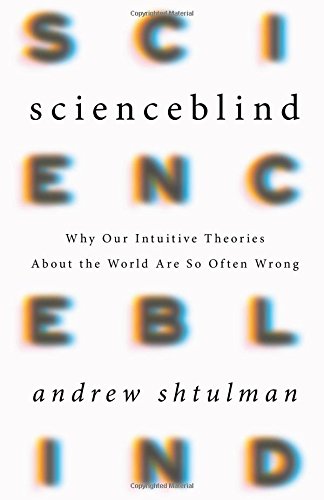
Scienceblind: Why Our Intuitive Theories About the World Are So Often Wrong
📄 Viewing lite version
Full site ›
Book Details
Author(s)Shtulman, Andrew
PublisherBasic Books
ISBN / ASIN0465053947
ISBN-139780465053940
AvailabilityIn Stock.
Sales Rank368,404
MarketplaceUnited States 🇺🇸
Description ▲
Similar Products ▼
- Free Will [Deckle Edge]
- Becoming Brilliant: What Science Tells us About Raising Successful Children (APA Lifetools: Books for the General Public)
- The Knowledge Illusion: Why We Never Think Alone
- Not a Scientist: How Politicians Mistake, Misrepresent, and Utterly Mangle Science
- The Enigma of Reason
- Behave: The Biology of Humans at Our Best and Worst
- Miracle Cure: The Creation of Antibiotics and the Birth of Modern Medicine
- The Influential Mind: What the Brain Reveals About Our Power to Change Others
- The War on Science: Who's Waging It, Why It Matters, What We Can Do About It
- Deviate: The Science of Seeing Differently